Pages

Monday, 18 July 2011

Leap of Faith

It may have become apparent by now, but I'm a lover of food. Ever since I was dextrous enough to slap my hands on a table, food has been something that excites me, that I want to learn about and that I want to share. My heart aches for those who have a difficult relationship with food, either through lack of it, fear of it, or through regarding it with insufficient understanding or respect, and I really believe in its power to heal, restore and transcend, if treated properly.

I have not, however, always had my current thirst for knowledge of it. I've never been a fussy eater, but like so many others, needed encouragement to push my own boundaries, both in terms of what I eat and what I cook. I have been shaped by many people in this regard. My grandmother, proprieter of 'Nan's Cafe' made me 'Uppity Cakes' because I wanted to know what they tasted like when she read me a bedtime story about them, and spotted my blossoming interest and allowed it to fire her own. My mother let me be free in the kitchen as soon as I could read 'Topsy and Tim's chocolate cook book' and is the first to pick up on comments I make on a recipe or food writer that interests me and run with it. My first love brought his gap-year restaurant job home, kindled my love of fish and recipe books, and taught me that I, too, could cook if I wanted to.

This hasn't been reflected in my choice of career, however, largely because I had no idea how to make it do so. I still don't have the long-term answer for this, but I am about to bring it a little closer. I've felt unfulfilled at work for some time now, the silver lining being the free time it allows me to cook, bake, research recipes and share food with friends. Being good at something does not guarantee enjoyment, I have learnt, and I have a GCSE in German to prove it!

Recently an opportunity to leave my job became clear and I decided to resign and give myself the push I needed to start acting on what I enjoy. Immediately, I found a position that matched my passion with my skills, and won an interview, only to find my lack of kitchen experience weakened my prospects. Undeterred, and with no other employment in sight, I handed in my notice and set about formulating a plan. If kitchen experience was what I needed, it is what I would get.

I've always been a believer that the best way to learn is to do, and that by showing someone how to do something new, two people stand to benefit. I considered my kitchen experience options and started making calls. Some nerve-wracking conversations, meetings, favours, discussions and meals (of course) later, I landed myself a combination job offer. I would split my time between an all-day seasonality-centric cafe and a modern european brasserie, both within half an hour from home, working a variety of shifts across all aspects of the business. I continue to feel very lucky for such an opportunity, and for the understanding of key people about where I'm coming from, and the fact that not even I know where I'm going to.

Having just reached the end of my first week, I am pleased to share that my decision seems to be going well! I've completed my first double shift, soon to become a foundation of my week, learnt about the opacity of chef's whites, washed, peeled, chopped, plated up and garnished everything from artichokes to tuna tartare. I have no scars yet but have been known to carry an unwipeable grin and effervescent conversation, two things that have been lesser-spotted for a while.

And so for the time being, this blog is going to recount my journey. I was asked this week if there was anything I particularly wanted to learn and I replied "Everything!!", so I will try to share my lessons with you. Wish me luck!

Tuesday, 12 July 2011

Let them eat cake

I make no apology for saying that when I make a cake for someone's birthday, it's a 75% selfish act. Yes, it's time consuming, yes, I could be out, or doing laundry instead and yes it turns my kitchen into a bombsite (I have yet to work out how not to carpet all surfaces in icing sugar when making buttercream or frosting with a bowl and an electric whisk instead of an as-yet-still-coveted Kitchenaid), but I find it therapeutic and very rewarding. Not to mention an excellent outlet for creativity as long as you're adventurous enough.

My cake-making is still in it's infancy but I'm proud of what I can do and it excites me to think of all the possibilities out there still to be discovered.

For now, I'll share with you what has so far proved a reliable formula so you can give it a go and see how easy - and enjoyable - it can be.

I use Nigella Lawson's 'Buttermilk Birthday Cake' recipe from my well-thumbed copy of 'How to be a Domestic Goddess' because, just like she says, it holds it's shape well, can support weight admirably and, most importantly, tastes delicious. I combine her recipe with Lorraine Pascale's (of Ella's bakehouse and 'Baking Made Easy' fame) technique of smoothing cake surfaces before icing and the result is fantastic.

So I thought I'd share how I do this with you by using my most recent cake as an example.

My cousin, who nobody can quite get their head around having turned 40, least if all himself, likes his music. A LOT. To say that he has more records than he has probably had hot dinners is, well, probably just accurate, actually. His house moves are a total nightmare. So I hear. I've always managed to escape them, unintentionally but fortuitously. So, before I was asked, I knew I wanted to make his cake, and I knew it was going to be a turntable. A big one. The quantities below are a tripled-version of Nigella's recipe, but doubling would be enough if you didn't want some cheeky leftovers.

Firstly, have your butter warming up to room temperature and line your tins. I used a 30cm round tin, an 18cm sandwich tin and a silicone muffin tray. Grease the tins with butter using some kitchen roll before lining with baking parchment. First cut a strip long enough to wrap around the tin with a little spare, as wide as the tin is deep plus 4cm. Fold the bottom 1cm of the length of the strip and then cut at 2cm intervals from the bottom edge to the fold. This will help it to curve smoothly around the inside of the tin. Cut a disc of parchment the same size as the bottom of the tin and sit this on top of the side strip's flaps.


Preheat the oven to 180℃. Using an electric hand mixer, briefly whip 375g room-temperature butter before adding in 600g caster sugar and creaming together. I tried using vanilla sugar, made at home with spent vanilla pods in a sugar jar, once, but found this made the cake overly sweet, not a good plan when you have buttercream and icing to add later. The sugar and butter mixture is ready when the two have come together and appear to have increased somewhat in volume due to the air. Add 9 eggs, one at a time, mixing each in well for about 30 seconds.

Have two bowls at the ready: one with 750g plain flour, 4.5 tsp baking powder, 1.5tsp bicarbonate of soda and a good pinch of salt sifted together, the other with a mixture of 600ml buttermilk (you will find that shops sell this in 284ml pots; it can be topped up with milk) and 4.5tsp vanilla extract - the best you can justify buying. Next, alternate mixing in at moderate speed a few good tablespoons of each in turn. This makes A LOT of batter:


Pour the batter into the largest prepared tin. It is safer to bake these one after the other as the oven shouldn't be opened until at least 75% of the way through cooking, and if your kitchen is a relatively serene environment the batter in the other tins won't suffer for it while it waits.  For deeper tins, start by cooking for 30m before checking to see if the cake springs back when lightly pressed and a cocktail stick comes out clean. It is likely to need longer, in which case cover the top with two sheets of parchment to prevent burning. My largest cake needed about 45m.

When the cake is ready, remove from the oven and leave for 10-20m before turning onto a rack to cool, and leave the parchment intact as this helps keep the cake just moist enough. Smaller cakes will need 30m plus.


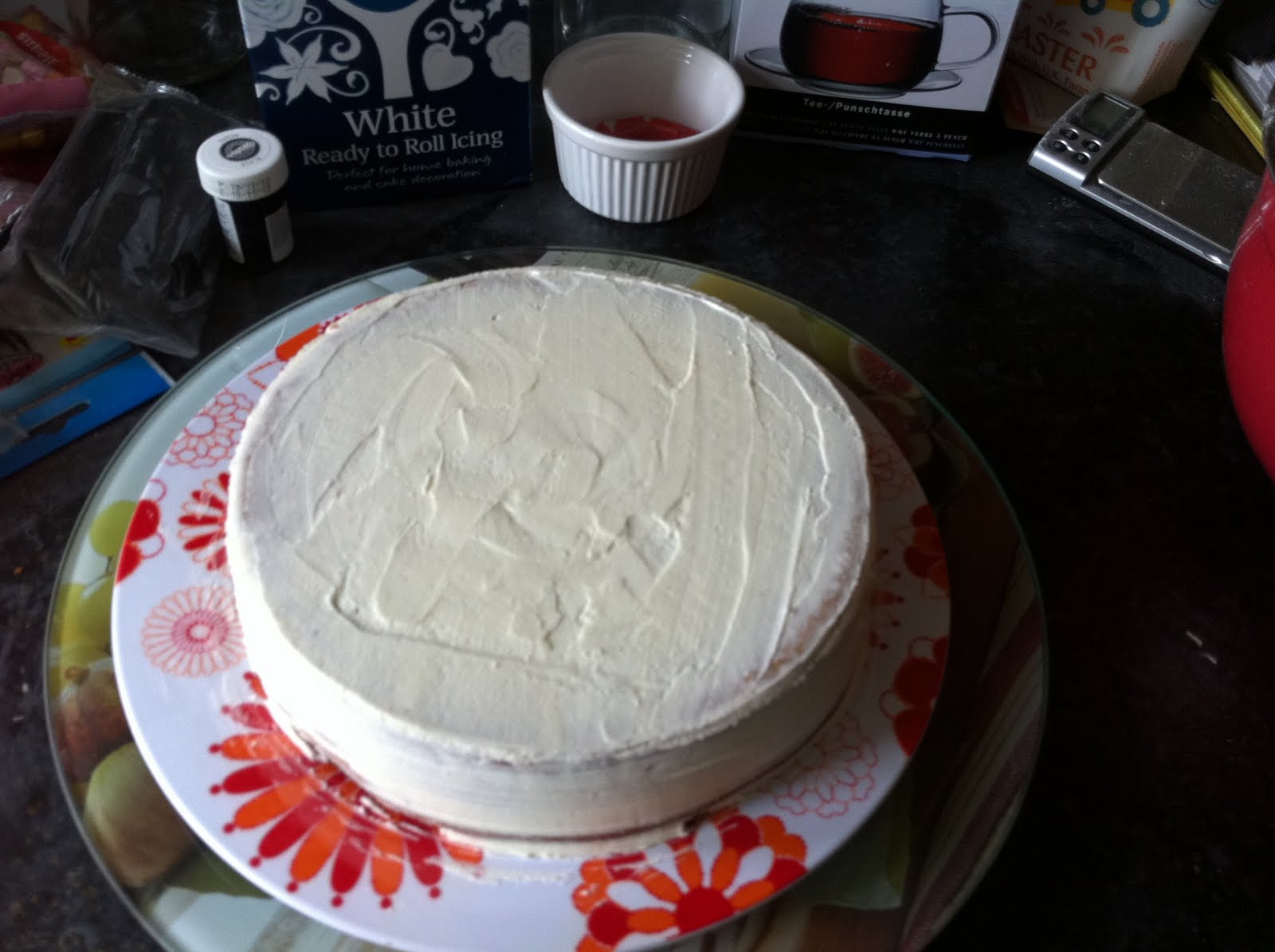
This is where the fun starts! While the cakes are in the oven, you can whip up the buttercream. Briefly whisk 300g room temperature butter to increase its surface area before whisking in a couple of tablespoons of 700g sifted icing sugar at a time. You will make a mess. Whisking through a hole in cling-film over the bowl could work, but is fiddly, and the cleanup operation doesn't take long. Each addition of sugar should be fully incorporated before the next. Once all the sugar has been blended in, add 2 tablespoons of milk (ideally whole, why skimp on the calories at this point?) and 1.5 teaspoons of vanilla essence. This is the point at which, should you be using the buttercream as standalone frosting, you could add food colouring, pastels working best. We're not using it for this, however.  If there are any particularly mutant-like lumps topping your cakes, these can be carefully carved off to create a flat surface. Then, using a pallet knife, cover the cake surfaces in buttercream like a master plasterer to smooth any dips, dents or bumps before chilling for half an hour. Repeat this so that you have 'plastered' two layers, the smoothness of the second being more important than the first. This will help the rolled icing to adhere to the cake and ensure a smooth finish, as well as adding a different texture to the finished mouthful.
Next it's time to cover your cakes. I bought a kilo of white icing and 300g of black from Hobbycraft, along with edible spray pearlescent icing, a small pack of orange icing, a pot of black food colouring paste and some cheap kids paintbrushes.  Stick the largest cake to a cakeboard, off centre in my case to allow for the 'headphones' later, using a blob of buttercream before kneading the white icing to soften. Dust a smooth work surface and a good rolling pin with a decent amount of icing sugar before rolling out your white icing into a round about twice the diameter of your cake and about 3mm thick. Use the rolling pin to lift the icing onto the cake and use the flat surfaces of your hands to smooth the icing onto the cake. You will need to carefully trim back the excess icing closely to the base of the cake. I used a thin 'rope' of black icing around the bottom perimeter - this handily disguises any uneven edges. You may additionally find it useful to dust your hands with icing sugar when smoothing the icing surfaces.  Reserving a ping-pong sized ball of kneaded black icing, create grey icing by kneading together the remaining black with white. Stick the next cake layer onto the centre of the base cake with buttercream and then protect the base cake with a sheet of greaseproof paper with a hole cut in it to fit over the second cake. This will stop you getting any grey smudged on your white base cake. Cover the second layer as before with the grey icing and then spray with the pearlescent icing, allowing to dry before removing the greaseproof and wrapping the base circumference with a black rope of icing.

You may want to cut out shapes from your leftover grey icing and spray these too, as I did with (40!) stars. I stick shapes onto my cakes with a blob of liquid glycerine, which can easily be bought from a supermarket, as this is clear and does not allow the shapes to slide.

Next for the record. I rolled out a disc of black icing as thinly as I could, whilst using as little icing sugar dusting as possible in order to keep the colour pure. This was cut slightly smaller in diameter than the top layer cake, and stuck to the top cake with glycerine. I used a clean comb to create the grooves, and painted the disc with glycerine to make it shiny.

To finish the record, I rolled an orange icing 'label', stuck this on as before and wrote on this using a fine paintbrush with the black gel food colouring. A silver candle provided the spindle. To make the arm, I wrapped a bendy straw in black icing and stuck this in a pillar of icing to the side of the top layer cake. The muffin-shaped cakes, with their lumpy tops, were perfect for headphones. I wrapped these in black icing, used a copper wire as the headband and a strawberry lace as the lead. And voilà! One turntable cake!

Check out my links on the left for details of Hobbycraft stores, for the spray icing as well as lots of other exciting supplies for whatever cake YOU decide to create!

I'd like to think that my cakes go down well, they certainly seem to!


Hearts

Butterflies

Turntable

Sunday, 19 June 2011

foodgasms (n. pl)

Let's take a detour. This blog may be called 'Sarah Serves' but this will not mean that it is restricted to tales of my culinary adventures. At times I will also share my views on those who Serve Sarah. And a few weeks ago, it was Heston Blumenthal, via the brilliance of his right-hand man at Dinner in the Mandarin Oriental hotel in Knightsbridge, Executive Chef Ashley Palmer-Watts.

Devotion to the cause, plus a nifty app, meant that S bagged a table for 6 as soon as round two of reservations opened and after a leave request, a painstaking wait and a guestlist shuffle, The Day arrived.

For those not in the know, Heston, of Bray's Fat Duck fame, rather enjoyed exploring what and how the British used to eat centuries ago, firstly through recreating dishes as per historical cookery books and then adding a modern twist to them, and this is the premise upon which Dinner is based. As such, the menu has dates and a bibliography.

The restaurant is within the Mandarin Oriental hotel and we rather enjoyed taking a pre-Dinner cocktail in the bar, which is suggestively decorated with beautiful back-lit liqueur bottles projecting their colours through opaque white walls like the ghosts of tipples future. The airy restaurant itself is shaped to allow a greater sense of intimacy than space between tables allows by breaking it into smaller sections, with a glass-walled kitchen so you can catch the magic on action. Including the spit-roasted pineapple (more on this later!)


We'd managed to secure ourselves a table overlooking Hyde Park, from which we could watch the Boris bikes and horses go by - if we could take our eyes off our plates for long enough. We got straight to the business of choosing dishes, with a desperation to try as many if each others' as possible. Nothing brings out the primeval pseudo-altruism more than a great meal, and it was clear that we would all feign charity with our own dishes because we simply HAD to try everyone else's.

Our beautiful-eyed cockney waiter talked us through some of the technicalities of the menu and we set about our battle plan with the zeal of oil prospectors. I assumed I'd have the meat fruit but did a deal with S, R and M, to secure a taste of it as well as Salamugundy (R's choice; as a medievalist by profession she was determined to restrict her meal to a set date period) and lemon salad in exchange for some of my marrowbone. Not my actual own personal marrowbone, you understand, although in retrospect, I possibly would.


Roast Marrowbone

Meat Fruit

Salamugundy
  Roast Marrowbone (c.1720)           Meat Fruit (c.1500)                Salamugundy (c.1720)

The Marrowbone salad was surprisingly light and subtly complimented with parsley and anchovy. I am usually wary of anchovies, finding the often limp fishiness atop a pizza to be a world away from the lipsmackingly melted saltiness in a lamb joint, but here it worked. The meat fruit was smoother than I had imagined, having seen it born on Heston's Dinners and remembering it more as rillettes, and was like the most sublime foie gras in it's butteriness, the mandarin jelly coating adding the perfect amount of intrigue. Salamugundy involved chicken oysters, the revered mouthful of dark meat from the back of the chicken ( http://en.m.wikipedia.org/wiki/Oyster_(fowl) ) which Louis XIV would insist on being the only part he ate. I now see why.


                                 Lemon Salad (c.1730)                         Roast Scallops (c.1820)

The lemon salad made me mourn the fact that goats curd cannot be bought within 500 yards of
my kitchen.  I missed out on trying the scallops, and need to overcome my unreasonable grudge about this, having not shared any of my dish with J in return.

Main courses followed a similar sharing pattern. Most ordered the powdered duck or the spiced pigeon, and M ordered the roast quail.

Powdered Duck
Powdered Duck (c.1670)

Spiced Pigeon
Spiced Pigeon (c.1780)  

Roast Quail
Roast Quail (c.1590)

Powdered duck is most closely related to a confit, with the addition of a protective salt shroud - the powder - which keeps the flesh moist and tender during it's six-hour cooking. The rich gravy helped this further. Fennel - which I really should cook with more - is not an accompaniment I would usually place with duck, nor one I would smoke, but it both took on the duck juices and leant a vibrancy to the meatiness of the dish. The puréed potato was a star in itself, a beauty that must easily have been 50/50 butter to potato, and that avoided being greasy but not having my greasy fingers swipe the bowl clean. See, primeval, like I said.

The quail was accompanied by smoked parsnip, creating a harmonious rich, sucré salé mouthful. The pigeon was beautifully tender and delicately, yet sweetly spiced, served with artichokes artfully arranged as camouflaged bones.

And then dessert. I may have surprised myself by not having the meat fruit, but I sure as hell was having the tipsy cake. This is where the famed spit-roasted pineapples mentioned earlier come into play. Tipsy cake is a brioche pudding, steeped in a sweet, buttery light rum liqueur to create a rich, custardy puddle at the bottom of its individual casserole and served with pineapple. The pineapples are roasted for 2-3 hours, depending on size, and the dessert must be ordered at the beginning of the meal. This is because it takes 30 minutes to cook, and requires 'basting' with liqueur every three minutes throughout this time.

Wow. My tipsy cake was luxurious, and yet light, the pineapple lending citrus freshness despite their caramelised syrup.

Chocolate Bar (c.1730)
I'm normally a stickler for a chocolate dessert but had no interest whatsoever in the 'Chocolate Bar' on offer this time, leaving it to J to enjoy, as much as the passion fruit and ginger ice cream intrigued me. Today, I was all about the fruit.

Summer Tart (c.1720)


I also tried R's summer tart with camomile and a biscuit ice cream, bang on trend with edible flowers and satisfying in its lightness.


Chocolate Wine (c.1710)

M enjoyed the chocolate wine, the two warm ingredients of dark chocolate and red wine having been merged through centrifugal force, and the accompanying Millionaire Tart would have taken a minimum of 5 hours to put together by R's reckoning based on Heston's 'In Search of Perfection' recipe.
Malted Barley Ice Cream (c.1830)


S decided to treat himself to a rather regal glass of dessert wine to accompany his malted barley and salted caramel ice cream, and having been allowed a sip I can attest to it's being worth it for a special occasion.


Still with me? We've not finished! Our beautiful-eyed cockney waiter brought us an earl grey ganache in a tiny teacup with a caraway biscuit. It was rather dribbly and therefore difficult to eat but no less delicious for it, it's bergamot notes singing through. E in particular enjoyed getting messy with this one.


I enjoyed an espresso with mine, but there was also some white tip tea and a 1970 Puerh on the table.


Dinner done, and at a price not at all unreasonable for such an experience, we went for a wander in the nearby rose garden in Hyde Park as a perfect finish to a wonderful few hours. Senses overwhelmed, I sat in the glorious sunshine people watching, and contemplating how lucky I am to have a table of appreciative gourmets in my close circle until sunset, when I headed home with a wide grin.

Sunday, 12 June 2011

A first time for everything

Trying something for the first time is often a daunting prospect, but usually one worth considering. You never forget your first time, so they say, and life is all about making memories. When it comes to food, there is so little to lose: you either like it, or you don't; either it works, or you'll need to try it again; at any rate, the worst result is you go hungry and the best is a fantastic success to brog about. 'Brog' is a new term I'm trying out for 'brag through the medium of blog', by the way.

Recently, I've experienced both. Although it was a deliciously moist affair that tasted divine, my attempt at Pam 'The Jam's honey and almond cake sank in the middle and so wasn't one for photographing. Fear not, intrepid followers, for I shall venture again soon and share further findings! I just need to buy a new electric hand whisk first in case this was a beating-by-hand issue, although that didn't cause problems with the lemon madeira cake so we could be in the realms of dodgy oven temperature. I will let you know.

I have been waiting for an opportunity to pay Ottolenghi a visit for some time now, and a very gracious friend helped me take that step. I didn't realise until later that he was using me as collateral for carrot cake due to a serious addiction but hey, he needed help and I was in the right place at the right time.
I didn't think a place that basically served salads could be worth writing home about. But, Mum and Dad, weather is lovely, and Ottolenghi is splendid. I won't write too much as it's been reviewed to pieces, so just go. Preferably at lunchtime. Try anything that has aubergine in it. Have the carrot cake. I promised the addict I'd try to recreate it and I have a suspicion that coconut makes an appearance. Perhaps as a soaking liqueur for the sultanas, perhaps to grease the baking tin. I also have a feeling there is some angel-cakery going on in order to make that crusty outer surface. All suggestions welcome.

And you know that famous saying, you never forget your first okonomi-yaki? Well, it's true. N has spent months in Japan, knows her stuff, and took me to Abeno as a special treat a few weeks ago, so I thought I'd share it with you.  For those not in the know, okonomi-yaki is basically a type of pancake. The tables at Abeno have a hotplate in the middle: you order your 'pancake' and it is made in front of you. We kicked off proceedings with gyoza....


I enjoy making these at home; they're a bit fiddly but this makes them therapeutic and so worth it; Ken Hom has a good recipe here: http://www.bbc.co.uk/food/recipes/porkpotstickerdumpli_90878


After our gyoza, we had tonpei-yaki:

okonomiyaki1

okonomiyaki2

okonomiyaki3

This is 'organic fried pork in an egg envelope' but we were most excited by its 'squirt of lemon'. The sauces are traditional - Japanese mayonnaise, Okonomi-yaki sauce and tomato ketchup. 

By now I was wishing that all tables had a hot plate in the middle. Think of the possibilities! Although this would not be ideal for romanic dinners and could lead to blistered elbows. You have been warned.

We decided to push the boat out with our main course and have noodles atop one of the pancakes. We ordered two - the Inaka mix, with pork, Konnyaku and corn, and the Spicy Naniwa, with pork and kimchi, to which we added noodles. The omelette ingredients are mixed in front of you before being poured into a perfect round to cook on the hotplate before flipping:


okonomiyaki1

okonomiyaki2

okonomiyaki3

The good thing about places like Abeno is that there is no risk of table-turning. It's a very sociable way of eating as you need to be patient whilst your food cooks and you can share the anticipation and fascination involved. It's also made to look impossibly easy but I know I wouldn't want to try flipping one of these bad boys any time soon! 

The finished, flipped article, once cooked through, was decorated with the obligatory sauces as well as bonito flakes and powdered seaweed. It was very filling, especially due to the time taken to eat it with chopsticks!


As for dessert, I have been discussing with friends cooking and baking with matcha. I shall be buying and using some soon, due in no small part to my dessert at Abeno: a Matcha hot cake with maple syrup, anko (adzuki beans) and shiratama (sweet rice dumplings), served with matcha ice cream. Don't be fooled by the slightly suspect appearance, it was delicious:


I hope that has encouraged you to go and try something for the first time today, whether eating or cooking, or just something new. My next post will also recount tales of an exciting first, so stay tuned!

Thursday, 2 June 2011

The Great Bank Holiday Foodie Weekender - Part Two.

Apologies for the delay in scheduling, hope you all had something to eat while you were waiting!

Day two rolled around and nothing gets the day going better than a classic with a twist. I haven't had maple syrup with my bacon since I was about ten years old, and I didn't like it. R and S have spent time in the States, and I have spent time in France, and we all now understand that the world of sucrée salée is a beautiful one, so it was time to give it another go. (Incidentally, I have a post on the way about 'first times' - keep your eyes open for this one!)

Needless to say, it was that good that we ate it too fast for pictures. Make sure you the pancakes are nice and thick, American style, that the bacon is British and welfare assured with a minimal water content, fried until crispy, and get the best quality maple syrup that you can afford. And then be generous with it.

Bellies full, we set off into the New Forest in search of a farm shop. We headed to Setley Ridge, a farm shop and vineyard in Brockenhurst, and saw lots of mini horses on the way. R and S have eaten horse so I didn't over-emphasise the fact that the French get their supplies from the New Forest... Once at the shop, we had a browse, a taste of the local wine and got supplies for the evening. On the way back we stopped for a proper cream tea, that is to say, in the words of N, 'a fat sandwich' - the order must be scone, (butter if available), jam and then clotted cream. With a pot of tea. We also had a savoury scone for good measure.

Dinner that evening was a mélange of meats: duck breast and venison, served on a potato rösti with asparagus (can you spot the leftovers? They were still prepared with love!) with port and shallots and five-spice peaches. Yes, we all imitated Michael McIntyre. The peaches were a Gordon Ramsay touch and brought the ensemble together. We drank local ginger wine which complemented the warmth and fruit of the peaches very well.


To round off the meal we enjoyed some local cheeses:


We had a New Forest blue and a Red Devil (which was really hot!) with fig crackers and a spiced carrot and pumpkin chutney. There was definitely coriander seed in the chutney, and I suspect star anise; it might be a nice one to try to make.


To cleanse the palate, we had made some raspberry sorbet. This is shockingly easy to make, dear reader, especially if, like me, you shamefully harboured an ice cream maker in a dusty cupboard at home blissfully unaware of the lack of effort needed to put it to use. Keep it in the freezer, and you're always ready to go!

Heat some frozen raspberries on the hob until they begin to break down and then lightly crush them. Strain this thoroughly through a sieve until you have extracted as much of the juice as possible. Add in a little sugar - about a quarter of the weight of fruit you have used - and any other flavouring you might want to try. I will add some freshly chopped mint next time, R and S often use rosewater. This mixture is then poured into an already-churning ice-cream maker and in no time, you have lovely sorbet!


And then, to end the evening we drank port and had yet more of yesterday's Intensément. Well, they both needed using up, so it was only right! We tasted some Original Beans chocolate as well, see S and R's blog for the tasting notes.

Breakfast the next morning was also designed to set us up for the day. We had venison, redcurrant and port sausages (which were just the right side of robust for breakfast) and served these up with oven-baked portobello mushrooms and cherry tomatoes, scrambled eggs and toasted bloomer bread. I would like to take this opportunity to heartily endorse adding jersey cream to your scrambled egg mixture. It worked.

The weekend ended on, yes you've guessed it, more chocolate cake. Too right!

Sunday, 29 May 2011

The Great Bank Holiday Foodie Weekender - Part One.


Ah, the end of May Bank Holiday. Unpredictability of weather, combined with wonderful seasonality of ingredients makes for a perfect 72 hours of viable cooking time. And what is better than 72 hours of cooking time? 216 man hours of cooking time!


Straight after work and a rummage through my freezer and cupboards, I headed to Wiltshire with R and S with no set plans other than to cook and eat outside of our usual weekend boundaries, and perhaps to relax a little too. A nice detour into Winchester en route for some local sausage and mash/grey mullet/steak and chips at a trip advisor-recommended pub set the weekend in motion nicely.

We picked some recipes and went in search of provisions. We stopped short of buying an ostrich egg (soft boiled in 25 minutes and makes enough scrambled egg for 24), but did splurge on some edible goldleaf and  fabulous chocolate. Both absolutely essential.

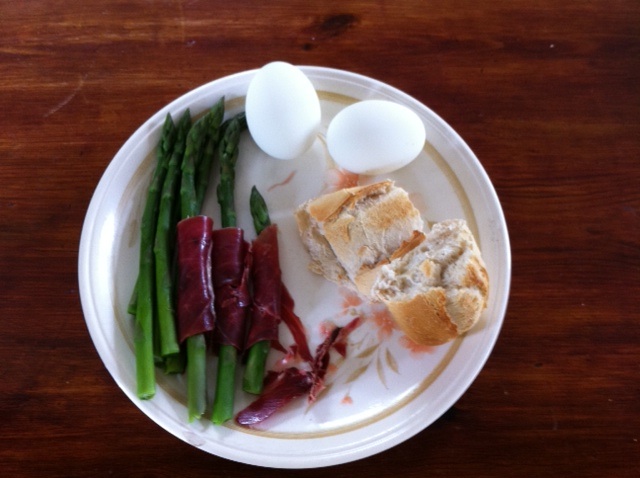
Meal number one: Soft-boiled duck eggs with poached asparagus and jamón ibérico:


Just a little snack, you see, to get us going for what was to come. I have the possibility of a trip to Barcelona soon, where I am assured that jamón ibérico grows on trees; this alone is enough to make me reach for Easyjet before consulting my schedule.

Then we set to work on a highly complex, multi-layered 'Intensément Chocolat' recipe from the Maison Ladurée sucré book.

Layer one: macaron. This is made the same way as a single macaron: sieved ground almonds, icing sugar and cocoa powder, folded into two egg whites whipped until firm. This was then piped onto a circle of greaseproof paper and baked at gas mark two for 25 minutes:


Layer two: mousse. Four egg whites and a pinch of salt were mixed until foamy, sugar added and whipped until firm before the yolks were added and gently mixed in with the hand mixer. A third of this was added to a cooled mixture of melted dark chocolate and butter before the ensemble was added back into the remaining egg white mixture and combined gently. This was chilled for a few hours whilst we worked on..

..Layer three: cake. Two egg whites were whipped with sugar until firm before the yolks were mixed in. To this was added a sieved mixture of flour, cornflour and cocoa powder before this mixture was also piped onto a greaseproof paper circle. This was baked at gas mark 4 for twelve minutes.

A ganache was prepared by heated cream being poured onto chocolate to melt it, before adding butter to smooth the mixture. While this was left to cool, we moved on to assembly time! 


(Clockwise from top left: cocoa syrup, chocolate mousse, chocolate cake, chocolate macaron base, chocolate ganache)


The macaron disc formed the base and on top of this a layer of ganache was spread. This was left to chill for a while while we ate dinner (see below!). Then a layer of mousse was piped onto the surface before the cooled cake layer was added. A cooled boiled cocoa syrup of water, sugar and cocoa powder was drizzled onto the cake layer until absorbed. On top of this was piped a second layer of chocolate mousse. This was chilled in the freezer for half an hour. 


Keeping up?

The whole ensemble so far was coated in a cooled chocolate glaze, made in the same way as the ganache but with milk instead of cream. All we needed to do then was to smooth the surfaces, add some goldleaf as decoration and voilà! 


I can attest to it tasting amazing. For reference, we used Valrhona 68% chocolate, golden granulated sugar and whilst the recipe suggests potato starch we substituted for cornflour.

Dinner this evening was kangaroo. S had looked up recipes online and found a delicious recipe hailing kangaroo as a lean, carbon footprint-friendly meat before realising that said website was Australian. We wanted to do something more special with this exciting meat than simply serving it up as steak and the recipe we opted for served the steak medium rare with beetroot, a shallot and port accompaniment and anchovy butter.  10 peeled shallots were placed in a small saucepan of water and brought to the boil before being drained and some of the water reserved. Once cooled, these were peeled and gently fried in a tablespoon of butter with a teaspoon of sugar and a third of a cup of the reserved cooking water. Once tender, about ten minutes later, the heat was turned up and a third of a cup of port added to reduce. With maybe a little more for luck. R made some lovely potato rösti with charlotte potatoes (specially selected for their waxiness) and just-right tenderstem broccoli, and whipped up the anchovy butter - three anchovies to a tablespoon of softened butter and a few drops of lemon juice. Meanwhile we had boiled two large beetroot which were peeled once tender and chopped.

The kangaroo was cooked for three minutes on each side and we added some of the anchovy butter while it was still in the pan before slicing on the diagonal. 


Kangaroo most closely resembles beef, with a wonderfully rich flavour and was nicely tender. We think it would barbecue well as long as it was medium to rare. The anchovy butter complimented it beautifully - we used salted anchovies (and unsalted butter) which served as the only seasoning necessary.

Check back tomorrow to find out what we cooked next! 

Tuesday, 24 May 2011

Soul Food

There are times in life when food serves as a comfort. And there are times when friends and family serve as the best comfort around. I count myself extremely lucky to be able to combine the two on a regular basis, whether for comfort or not. But there have been moments such as these recently that I will always look back on with warm smiles as they have truly nourished my soul. This post is dedicated to those friends and relations, who know who they are. Long may we be nourished together!

My first self-nourishing act A.R.C (After River Cottage) came in the form of a birthday cake, straight from my freshly purchased Baking book by Pam 'The Jam' Corbin. Attempts by Olly at Park Farm, coupled with hours of squinting furiously at roadsides had sadly resulted in a distinct lack of crystallised borage flowers to decorate said cake, but no matter, I decided that the flavour of the lemon madeira cake would be the focus.

Armed with my super-duper-smooth-it-to-a-baby's-bottom-zester (perpetual thanks to N), I zested two lemons and creamed the zest with 150g softened butter before beating in 150g golden granulated sugar until light and creamy. 4 eggs were mixed in, one at a time, with a spoonful of the sifted 200g plain flour and 1tsp baking powder between each. The remaining flour was then gently folded in and 2tbsp lemon juice added. The batter was poured into a greased and lined 1 litre loaf tin, its surface smoothed before baking at 180C/gas 4 for 50 mins, or until golden and springy, with a cake tester coming out clean. The cake was left for 10m to cool in its tin before turning onto a wire rack to cool completely. When cool, 150g sifted icing sugar mixed with 1.5 tbsp lemon juice was oozed over the top. Lovely job.


Then it was time to hand over to others to nourish me, or at least to act as facilitators. And, in one word,

Truffle oil.

A delightful Italian taverna near Hampstead Heath taught me that being a boar ain't so bad if that's what you get to smell out. My fettucine dish was a controversial union of hunter and hunted - wild boar ragu with white truffle oil and I reluctantly had to share some, having promised a taste to a friend who swapped for a mouthful of her delicious pear and gorgonzola risotto.

The following day was filled with baking, and, as a consequence of the night before, more truffle oil. With the help of two fellow intrepid foodies, R and S, we recreated ciabatta a la R.C, although our version was perhaps a little dry, but what fun was had reliving Gideon's dough-kneading techniques in the comfort of my own kitchen! Instead of olive, we used white truffle oil which gave the kitchen a wonderfully heady aroma and gave us wide, dreamy grins. Dryer or no, it all went. Fast. It was great to prove to myself that not only had these skills persisted beyond the course, but that I was able to share them with others.

And then it was their turn to share. These friends are macaron aficionados and we (rather, 'I') have been itching for an opportunity to make them together. The basic recipe is fairly standard, with the filling and technique making all the difference. Point one - the eggs must be spankingly fresh and the whites must be totally yolk-free. Ground almonds and icing sugar are carefully forced through a sieve and artfully combined with stiff-peak-whipped egg whites. Colouring can be added at this point to your taste, we went for a sunshine-y yellow.

Because we are mild(!) perfectionists, we piped the mixture into a biscuit cutter to make them perfectly round:


Then came technique point two: to get the most consistent macaron shape, the piped mixture needs to be left to form a 'skin' before it is put in the oven. We left ours in the lounge with a fan circulating air in the room (probably a good idea to dust before you do this, unlike me...). Explaining to the first guest that no, this wasn't anything to do with keeping the house cool, it was purely for the benefit of the macarons was an amusing moment. Half an hour later they were ready to go into the oven at a low temperature so that we could watch with bated breath (and very, very sexy socks)...


While the macarons were cooling, we made a chocolate and coffee paste with melted and rapidly cooled chocolate whipped with a little water.  This sandwiched half of the macarons, and pumpkin jam lovingly gifted from N's trip to Portugal sandwiched the other half. And that was all we needed to do for these beautiful pieces of perfection:


While these sat coaxing us gently from another room, we got on with making lunch. Yes, lunch. Doesn't everyone make ciabatta and macarons before lunch at the weekend?! To accompany the ciabatta I demonstrated my new-found mackerel-prepping skills and these were baked with salsa verde as they had been on the course, and served with a green salad.

You can't have soul food without a little chocolate brownie involvement. Earlier in the week I had spotted a recipe by Gwyneth Paltrow that had to be tried. Amazingly, I had most of the ingredients already, so we got straight to it. 200g flour (spelt was recommended but plain worked fine) was sifted with 100g cocoa powder, 1.5tbsp baking powder and a pinch of salt into a large bowl. In a separate bowl, 125ml vegetable oil, 250ml maple syrup, 125ml rice syrup, 125ml freshly brewed coffee, 125ml milk (soya suggested, we used ordinary skimmed) and 1 tbsp vanilla extract were whisked together. The wet ingredients were mixed into the dry ingredients until just combined and half was poured into a vegetable oil-greased baking dish before sprinkling in 100g plain chocolate chips. We used cocoa nibs to give a bit of extra interest, not to mention antioxidants. The remaining mixture was then poured in, another 100g of chocolate chips added before baking at 180 degrees C for about 30 minutes (the testing stick should come out fudgy!). Highly recommended, unfortunately these did not last long enough for a picture...

The rest of the evening was spent watching 'Julie and Julia' (highly appropriate, no? A wonderful film that I thoroughly enjoyed) and eating personalised pizzas. Not stone baked this time, but there was still chorizo, garlic oil and mozzarella involved, so the smiles were the same.

The next day I went to the Real Food Festival, just to pick up a few things...


Stay tuned, eventually I'l get round to using and writing about some of these, making this a very clever spot-the-ingredient picture. The book has some lovely recipes in it, too, so no doubt these will also be making a guest appearance.

All in all, a wonderfully soulful weekend. Wouldn't you agree?