Pages

Monday, 3 March 2014

Terms of Endearment

So, today was possibly the first day of the rest of my life.

I am very glad to have been reassured, so far, that my choice to undertake a cookery course at Ashburton Chefs Academy seems to have been the right one. 

Day one involved an outline of the course itself, which looks like it will be very intense. The focus of the first week will be working towards our Level Three food hygiene qualification. We also got kitted out in chef whites, had our mugshot taken and got to know each other, our favourite chefs and why we've all chosen the course. Today we were tutored by two truly inspirational chefs. Leading us was Rob Spencer, who has been sous chef at l'Ortolan, worked with Gary Rhodes and was Head Chef at John Burton-Race's Michelin-starred New Angel in Dartmouth. Assisting him was Colin Bennet, a talented pastry chef with a career including Head Pastry Chef positions at The Waldorf Hilton,  Nuno Mendes' Viajante and Jamie Oliver's  Barbecoa. 

My eight fellow coursemates have a variety of different backgrounds and aspirations, from working on private yachts, to fulfilling a lifelong dream to enrich a passion, to people like me who aren't too sure what's coming up next. 

After being shown around our home for the next six weeks, we were let loose in the training kitchen. These have a number of stations decked out with all the necessary equipment, super-fast induction hobs and ovens too complicated for us to use on day one. I've always been wary of induction hobs, but am becoming a convert after just one day of being shown how quickly they work, how precisely they can regulate temperature and how accurately they can be controlled. 
Taken from
http://chasingdelicious.com/kitchen-101-knives-basic-cuts/

Today's core skill set was vegetable preparation and cutting. Although it was already vaguely familiar, it was good to establish that baton is to macedoine as julienne is to brunoise, that you can chiffonnade a leek but not a tomato, which you can concasse but not paysanne. Nobody was hurt in the making of day one.

We made a vichysoisse, a leek and potato soup, by softening finely chopped onion (brunoise), finely slicing a leek split in half (chiffonade), adding smallish cubes (macedoine cut) of potato and cooking in vegetable stock made on site before blending. Then we made a vegetable broth to practise and demonstrate various chopping skills of shallot, knife-puréed garlic, carrot, fennel, celery (always peel it, people!)leek, cored, blanched and peeled tomato, and chives. We made our own bouquet garni with herbs wrapped in a layer of leek and we added cooked pearl barley. These two soups will be our lunch for the next two days, so if it all goes quiet on this blog you will know that I only have myself to blame!

Tomorrow will be day one of our food hygiene course, but it will also be PANCAKE DAY! So either way, there will be good stuff to check back here and read up on!  

Sunday, 2 March 2014

When one door opens...

Friday, 28th February 2014 was officially my last day managing the cafe after the decision was made by the business to close it down. The end of an era and the finish line of a fantastic journey. Although this was incredibly sad, I am so grateful for lessons I've learnt and friends I've made along the way.

This post was going to detail some of what is involved when a small food business needs to close. What happens with stock, suppliers, finances, equipment... but this is now another post for another day. When I learnt that my role had definitively come to a close, I did what I do best, and acted fast to keep myself learning and moving forward.

And I booked myself onto a professional cookery course.

That makes it all sound very easy, and it wasn't. I had been contemplating this as a possibility for some time, and deliberated carefully over what course to do, where to do it and why I should do it. None of this is helped by a rather sizeable degree of uncertainty over what I want my future career to look like. I know that I love food, that I delight in enthusing others about it too, and that I am probably not headed towards opening my own restaurant. I also feel that my experience in food could do with being underpinned by some solid qualifications.

After considering various big-name cookery schools as well as adult learning options, wondering about balancing between time and financial investment and return, I decided to book myself onto the six-week Professional Culinary Certificate at the Ashburton Chefs Academy. This happens to be a half hour drive from where my other half lives, which in itself is rather handy.

So, all paid up, signed up and with forms detailing what size chef whites I will need, the course starts tomorrow. I am a walking cocktail of excitement, trepidation, exhaustion and back-to-school nerves. My plan is to blog about my course every day, so keep an eye on my progress right here!

Sunday, 19 January 2014

Waste not, want not!

Once the festivities of December have come to an end, with its giving of gifts, spectacular feasts, and time with loved ones, thoughts often turn to restraint. January is a time when we are most likely to tighten our belts – both financially after the impact of the most expensive time of year, and in terms of our health, when we cut back on things we enjoy but which we know, in excess, can cause us harm. In this way, the start of the year is a great time to make sure that we take responsibility - for the costs of our lifestyles, for the need to look after our planet and recycle all that packaging and paper so prevalent in December, for our own wellbeing, and to consider those who are less fortunate, who have a less stable support network than we may have ourselves.


Much has been reported recently of the growing issue of food poverty in this country, reported to affect four million people. The Trussell Trust, which is the largest operator of food banks in the UK, reported a three-fold increase in the number of people it distributed food to between April and September 2013 compared to the same period in 2012[1]. The Red Cross started sending volunteers to supermarkets at the end of November to help collect food donations from shoppers to distribute to foodbanks in association with the charity Fareshare[2]. The UK’s first social supermarket, selling products deemed unfit for sale due to having damaged packaging or being the wrong shape or weight, opened in December in Goldthorpe, a former mining town classed as an area of high social deprivation. A petition declaring food poverty levels in the UK as a public health emergency has now been delivered to Parliament demanding the issue is officially addressed by the government.  And yet we throw away 7 million tonnes of food and drink from our homes in the UK every year, more than half of which could have been eaten[3].


Fantastic ingredients donated for a FoodCycle session
in December - we had to google salsify!
I have recently become a volunteer Hub Leader at my local FoodCycle in the hope that I can do my bit to address these issues. FoodCycle is a national charity that aims to turn food surplus into healthy, free three-course, restaurant-style meals, thus reducing waste and also providing a way to build communities and feed those who may struggle to feed themselves. There are seventeen FoodCycle Hubs in the UK, all run by teams of local volunteers such as myself donating their time, working with food donated from local supermarkets including Sainsbury's, using facilities in ‘donated’ cooking spaces like local community centres. We don’t use meat or fish, meaning the food risks are low, and welcomed financial donations from within the community help keep us equipped with any kitchen tools and extra ingredients we may need. Every week is like a mass-scale production of ‘Ready Steady Cook’ as we have little to no idea of what ingredients we will have available and with volunteers changing every week, it is a challenge to balance the cooking skills of the kitchen staff with the commitments of delivering a tasty restaurant-style meal to an unknown number of diners! The volunteers take it in turns to eat as well, allowing us to get to know our guests and engage with the community.

By the end of the session there will inevitably be some ‘surplus surplus’, ingredients we had too little of to use or that didn’t fit in with our menu, and we do our best to ensure even these are put to good use by providing a takeaway service. Having worked in both a supermarket and a number of eateries myself I am only too aware of how much wastage goes on in both ends of the food industry and every time I volunteer at my local Hub I go home exhausted but elated to have done my very small bit for the universe. You can, too by signing up here.


You may have noticed, as did so many people (myself included) that you had food that didn’t get eaten over the Christmas period, despite all good intentions. Here are a few tips to help you control your waste this month, and to lessen that inevitability for next year.

  • Buy wisely

Original picture can be found here
We’ve all been there. The biggest local supermarket on Christmas eve was a sea of furrowed brows, discarded shopping lists written on card envelopes fluttering in the bottom of trolleys and tired parents wishing they’d done it online. Breathe. It’s January now, those dark days are over. Never go food shopping when you are hungry, as you will buy more than you need. And bear in mind the lovefoodhatewaste portion calculator. For example, it recommended 8 brussel sprouts, 80g carrots, 5 small roast potatoes and 140g turkey per person for Christmas dinner. This comes in pretty close to the portions for the ‘perfect Christmas dinner’ revealed by food psychologists Dr David Lewis and Dr Margaret Yufera-Leitch to leave you satisfied but not stuffed. How many of you had leftover sprouts after Christmas dinner, leaving you with the dilemma of choosing between food waste and extra ‘ammunition’ for someone’s digestive system the next day?

  • Stock up
Many of the big supermarkets are giving advice on leftovers right now. Once your roast meat has done its Sunday lunch duty, remove all the meat you can from the carcass and set it aside. This can be used for the next two days for a delicious curry, pasta dish or pie. Otherwise, portion up cold leftover meat and freeze it in clearly marked airtight bags for up to three months[4]. Defrost thoroughly before use. The meat bones can then be boiled up with a roughly chopped onion, carrot and celery stick, a bay leaf or two and a few whole peppercorns to make a stock you can strain and use or cool and freeze for soup.

  • And freeze!

The freezer can be a wonderful friend for many leftover ingredients. Eggs nearing their ‘Use By’ date? Raw eggs can be beaten and frozen for up to three months. Clingfilm butter and freeze it for cake day for up to six. I find well-wrapped sliced bread toasts better as the inside of the slice dries out less in the toaster. And of course, leftover herbs can be chopped and popped into icecube trays for when you need them. 

  • Get rotten 

If you don’t already have one, this may be the time to set up a compost heap. Try to ensure that food that really can’t be used any other way is at least composted where possible. This excludes bread, meat, fish and dairy. Compost does wonders for your garden (where you could also try growing your own herbs and vegetables in pots), but if you don’t or can’t have your own heap, it is likely that your local community garden will do and they may welcome your compostable waste. My local FoodCycle uses herbs and vegetables from our local community garden, who accepts and composts our food waste after sessions and this makes our community links even stronger.


These tips for resourcefulness should help anyone, whether you have too much food or not enough. At Christmas and in January, it is more striking than usual that while there seems to be more than enough food to go round, many still go hungry. So if you’re lucky enough not to be part of the reason that food poverty is being put to debate, at least make sure you’re not part of the reason so much food goes to landfill.

Sunday, 27 October 2013

A Year In The Life

I have often been heard lamenting my own neglect of this blog in the past year and a bit, so, my apologies for taking so long to do something about it. I’ve had quite a year, biting off, if not more than I can chew, then certainly enough to stop me being able to talk. The last many of you will have heard from me, I was freshly returned from Paris having been filling my days with macaron missions, baguette brilliance and pastry passions. My Gallic adventure taught me a lot about myself, not least being that somewhere, there is a career in food for me to knead into shape. So when I returned I had the good fortune to hear about, apply for and win a new post with my old employer running a training cafe in their flagship centre.

I hope you’re strapped in and ready for a whistlestop tour of my past year in the food industry to make up for my silence. It has certainly been a bumpy ride and regardless of whether I’m driving or not, I remain in the dark not only about the destination, but sometimes also about the general direction I’m travelling in. There are no emergency exits.

Here we go…

August 2012
First day of the Olympics.
Also first day in my new job managing a training café within a centre designed to help the unemployed back in to work through a variety of skills programmes and vocational qualifications.

In Stratford.

Attached to the Olympic park.
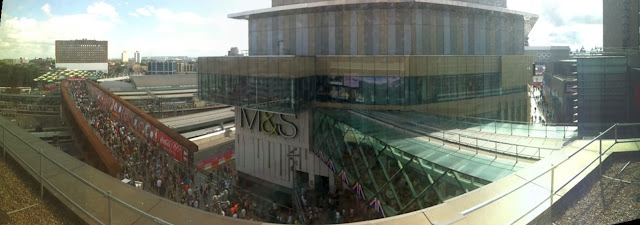
A View from the top on another 'quiet' August 2012 day in Stratford.

My first two weeks are spent getting to grips with the challenges of a commute to and from the Olympic Park, as well as those facing the café as a business, which include an embargo on advertising outside of the building, a high proportion of young people on low income from one of the most ethnically diverse London boroughs and revenue targets that can never be achieved without several other income streams. I earn my Level 2 Food Hygiene certificate and get to grips with flashy equipment that has been gathering dust for a year before recruiting my role seemed like a good plan. No coffees are made for two weeks until I manage to persuade the airport-style security in place in my building that I have no intention of manufacturing a bomb from the espresso machine cleaning powder. I sell a few kitkats and cokes that have been bought in from the local cash&carry and start making demands for useful equipment like a stock cupboard, a hob, a freezer…  

No suppliers are in place so I build these contacts from scratch and negotiate shopping trolleys full of stock across the bridge to the Olympic village while juggling running the café, writing a café manual and dealing with stock spoilage issues inevitable not only due to the low levels of traffic but also from nightmare delivery logistics due to the Olympics. And then the Paralympics.

September 2012
The centre’s cleaners hand over to me full cleaning responsibilities for the café and I become even more militant about access to the kitchen and cleaning logs. Café staff uniform is organised even though I remain the only staff member, and my Mum is put in charge of sourcing thread to match the logo and getting them sewn up. I win the fight for the e-POS till from the training shop to replace the corner-store style carbon printer till system and get to grips with programming the expanding menu onto it. I quickly learn to triple-check my shopping list against a delivery note and the delivery itself, that relying on others to sign off cash requests inevitably leads to significant personal spend and that non coffee-drinkers can still make a reasonable latte under my instruction.

THE FREEZER ARRIVES!

And in my infinite wisdom I decide to fill it with ice and smoothie fruits.

I also acquire a hob and can stop using the combi-oven to melt things.

Having become a feeder with my reliable homemade flapjacks and banana bread it is decided to launch the café in an official capacity with a MacMillan coffee morning. A week of evenings alone in the ‘office’ late at night in an icing-sugar fog produces a dazzling display of cupcakes, brownies, cookies, biscuits and muffins, especially considering they’ve all been made in a combi-oven that barely fits two trays of cupcakes. Nearly everything sells out and a handsome cheque is sent to the charity.

Sadly, due to an oversight, the photos and quotes about this never make it into the company magazine.

By this point, it has become clear that the original design for the café and the use to which it has been intended by the Powers That Be are somewhat at odds with each other. A catering space with a two-shelf combi oven, no integrated hob and one food prep work surface was never designed to be a fully functioning bakery-café. Especially one made of white surfaces blemished by the merest whisper of a caffeine spillage. This notion is quickly put out of mind while catering orders start coming in thick and fast, meaning I find myself at times juggling running the café, baking for the cake sale and catering for a business lunch for 40. And just like that, the advert for an Apprentice is finalised.

October 2012
The menu expands according to customer feedback and a large volume of multi-portion soup pouches are bought in. Spare space in the freezer is rapidly filled with part-baked rolls, pizzas, sausage rolls and batch-baked cakes. Surprisingly, customers don’t really enjoy waiting for their sausage rolls to be baked to order. Soups sell at a rate of about a portion a day resulting in huge wastage. Apprentice applications are not hugely forthcoming to start with but finally result in a few in-depth interviews and day-long work trials before selection of what I hope to shape into my mini-me.

Loyalty cards arrive to encourage the drinking of proper coffees and with the help of with a good number of freebies, these begin to take off. My colleague on reception burns through almost a card a week from this point on and we quickly develop a routine few understand where the response ‘Yes Please!’ is elicited either from simply saying his name or by asking ‘Mental?’, otherwise known as his daily three-shot latte. On a bad day, it’s time for a ‘Totally Insane’ four-shot. The arrival of a chalk board sees me getting creative drawing suspect-looking chocolate chip cookies in what soon appears to be permanent marker on the price board. I nervously hand over the daily routine of getting the staff hot drink station set up to the centre manager and leave the country for a few days to indulge in the gastronomic and oenological delights of San Sebastian and Rioja. Bar a massive clean up on my return, nothing goes horrendously wrong.

November 2012
Mini-me starts, and not a moment too soon. I am left to get by while she completes a two-week hospitality training programme to get her covered for food safety. By her third full day in the café I am having to deal with the guilt of abandoning her to customers while still so ‘green’ while I prepare lunch platters for 40 people. Mercifully, this is an otherwise quieter month, allowing me to concentrate on getting mini-me fully inducted into the company and café ways of working, set up with the best and most relevant units for her apprenticeship and experienced in as many aspects of café life as possible. 

Which is just as well, because torrential rain in the West Country means I am stranded, albeit creating a lovely long weekend with my partner, and off from work for the 30-person meeting that needs catering for one fateful Monday at the end of the month. She takes it all in her stride as though she had been taught like a pro.

December 2012
A trainer from the coffee company arrives and changes my cappuccinos, for the better, forever. Not only do I learn that coffee bean quality deteriorates months before its Best Before date but I finally achieve a silky mouthfeel to my steamed milk that I still believe only a few independent coffee bars can match. The resulting stronger sales mean that the till float has to be increased for the first time and the café’s image as a ‘tuck shop’ begins, slowly, to wane.
Got milk?

Now that I can do latte art properly I entertain a couple of requests. Admittedly, my latte boobs need a bit more work.

Increased sales mean the first signs that the café was not designed to be much more than a training facility begin to show. Aesthetic but un-hardy cupboards begin to suffer, the very real need for increased storage and worktop space is demonstrated during the chaos of a lunch rush and the domestic-style dishwasher breaks down. In the absence of any other solution I am also forced by necessity to buy a second microwave to cope with the volume of staff lunches that need heating, mine being the only food preparation space in the centre.

Ahead of the Christmas do, a secret stash of wine is passed to me to chill in the fridges. Nobody remembers to count them first. I call it my Christmas bonus.

The best day of work this month comes on that peaceful day between Christmas and New Year when most staff are still on leave. I come to work in my chef’s trousers and bake all day, undisturbed, content in my quest to stock the freezer with homemade cakes for the next few weeks.


January 2013
Slow sales at the start of the month due to post-Christmas cashflow issues and good New Year resolution intentions are predictably short-lived. My cakes are blamed for the lack of will for a good proportion of my colleagues. I make use of any quieter time brought about by these good intentions to address improvements necessary to café layout, security, maintenance and equipment. I start investigating takeaway packaging now that interest from the other office on our floor has coincided with a noticeable number of un-returned plates.

Mini-me’s diligence at working on her Apprenticeship units cannot change the fact that my ambitions for her were slightly out of her reach, as well as not being entirely feasible given the café’s setup, and her programme is adjusted to become more achievable. Keen to ensure I support her the best way I can, I start a teaching qualification which also gives her the opportunity to run the café alone one afternoon a week. We get the year off to a good start by logging many of her daily tasks to provide evidence for her portfolio and I get her creating adverts for some of the café’s products.

I manage to forget to turn to page two of a refreshments booking form for a meeting of important delegates and have to leg it to M&S to buy sandwiches, cut them in half and present them on a platter once they point out lunch is half an hour late. Thanks to marathon training I manage to do this without looking too much like I’m about to pass out.

February 2013
Perfect Valentine's Day fare...
I learn that if you add red glitter to stuff, people will buy it in the name of Valentine’s Day. Likewise if you stick a chocolate-dipped strawberry on top. Or pink buttercream. Or make anything with edible hearts.

Colleagues start to notice my London Marathon sponsorship forms papered around the centre and some deduce a link between this and my occasional agony whilst walking.

After much wonderment and many random mid-afternoon outbursts of ‘did-you-know’-isms resulting from researching McGee’s Food and Cooking, I complete my teaching course by delivering a training session to my peers all about the wonder that is the humble egg. I continue to this day to hope that their apparent enthusiasm was not solely caused by the peer-criticism arrangement in place for passing the course. In return, I have sat through a training session on the Offside rule and learnt how to bellydance. Partner weeps with joy.

March 2013
Five months in to her apprenticeship, mini-me’s performance starts to become a little erratic. Now fully into the swing of things, tinges of boredom are beginning to set in, resulting in an increase in lateness and extended lunch hours. Mini-me and I have a meeting to address her dissatisfaction at having to repeatedly carry out cleaning tasks, sometimes while I get on with accounting or liaising with suppliers. Along with my own manager, mini-me is given the sort of short-course in ‘Life 101’ that I wish I had had by her age:
  1. Life is unfair.
  2.  In order to achieve your ambitions, you will have to work hard, and start from the ground upwards.
  3.  Nobody is going to be your salesman for you like you can be for yourself.
  4. When you are given a rare opportunity to work in a supportive and nurturing environment, utilise, but don’t abuse.

The café caters for its first evening event, providing a selection of hot and cold canapés and wine for 50 people, and we work well as a team. The bruschetta I stayed late to prep the night before is a particular success and I spend the rest of the week devising ways to use up two kilos of wholegrain mustard. Chocolate-dipped strawberries are reprised as cake toppings to use up the excess from my slight overcatering issue.

The microwave breaks through the sheer volume of staff food being reheated in quick succession during the lunch service. The small mercy is the time I can drag out not reheating any more while I await the recalled receipt from head office archives for a replacement. I am amazed at how much emotion this stirs in my colleagues, as well as how many of them manage to actually have a lunch break.

April 2013
Most of this month is taken up by running, carb loading, and preparing for the Marathon fundraising bakesale. Themed bakes such as Rocky road bars, cheesey feet biscuits and ‘Marathon’ brownies go down well and help me to exceed my fundraising target. The fact I broke the office printer by trying to print my sparkly glitter iron-on name transfer at work almost goes by unnoticed. Ottolenghi’s carrot cake becomes the stuff of café legend. The sale does at least make it into the staff newsletter this time, but not before a minor dispute between accounts and marketing over who gave it the original go-ahead in the first place, making me wonder for the merest second why I bothered. I have my first family visitors to the café to support the sale, and get another glimpse of just how helpful advice from a third party can be when you are so immersed in running the show you lose sight of what it’s like to be in the audience.  

The dishwasher breaks down. Mini-me and I both quickly arrive at the conclusion that washing everything up by hand in one sink is not as much fun as Fairy adverts would have you believe, nor does it make your hands as soft as your face, unless you are House. On my day off work after the marathon, my reward for being able to move is, naturally, taking advantage of someone else’s cakeshop. It might have even been two…

May 2013
Being personified in icing should be
on everyone's bucket list!
I reach a landmark birthday and indulge in much wonderful baking from others: fresh and hot madeleines from St John Bread and Wine and a wonderful personalised birthday cake.
I even manage to treat my poor feet, overworked all day for the past nine months as well as put through over 500 miles of running, to a rejuvenating pedicure. I take the opportunity to consider how lucky I am to be in a position where I can still explore what career path will make me happy, and to have such wonderful and supportive people around me.

Plans are developed to extend the café’s training offer to include short-term work experience placements for young people about to embark on hospitality apprenticeships. I set about designing a training programme for these placements to include all the key aspects of working in the café as well as experiencing a variety of different shifts.


At the end of the month, I learn my saddest, but most valuable lesson in the Hospitality industry so far: you can trust a member of staff completely, pour your energy and what you have learnt yourself into training them, supporting them, giving them experience and responsibility that they wouldn’t otherwise enjoy at such an early stage in their career, sing their praises, and they can still let you, and themselves, down in the most heartbreaking of ways.

Irrevocably.

June 2013
I am back to working as a one-woman band in the café, for the foreseeable future. It is around this time that the Powers That Be decide that the café is not generating enough of a return on its investment and opportunities for putting it to use as a revenue-generating training facility need to be maximised.

My line manager leaves the company. Suddenly staff begin ordering toast first thing in the morning again, now that they are no longer banned from eating at their desk while they check their emails.

Post-marathon, I am keeping fit by repeatedly having to carry up to 36 pints of milk at a time from ten minutes away. All well and good unless any or, as is often the case, all of the below apply:
a) it’s raining and windy – quite a likely occurrence in London, 
b) all the elevators between the café and the supermarket are broken 
or c) the milk starts leaking on the way back all over the bread, sandwich fillings and me, causing a mini meltdown while I empty my shopping bags of purchases to pour away the spillage and almost actually cry over spilt milk.

July 2013
Preparations are underway for the next phase of café development and I work on advertising opportunities to increase footfall and give the prospective trainees more customers with whom to practise their skills. The menu is refreshed and packed lunches grow in popularity despite questionable British summer weather. All that frozen fruit finally gets put to use in smoothies and berry muffins. The café gains a working glasswasher, a stock cupboard and a long-awaited second kitchen worktop. I see in my one-year anniversary on a well deserved holiday.

And so, into Year Two...
Since my one year anniversary in this role, I have thought a lot about the future. The café has been my baby, brought up from birth in the most part by a single parent, and I have learnt a lot, grumbled often and shed blood, sweat, tears and pounds through my work. I am proud of what I have achieved, never satisfied with how things are and at times frustrated in the lack of vision surrounding me at the potential of what I do. I have been steadfast in my belief that giving customers what they think they want is not always the right thing to do; I have resolutely resisted pressure to stock energy drinks, burgers and high-sugar chocolate cakes despite knowing how much the younger, seemingly more solvent students want them. I have been truly touched by the colleagues that recognise my hard work, the smiles I elicit from a regular customer when I have their order ready before they ask, the opportunities I am given to help someone make a healthier food choice. I know that I still have so much more to learn. Getting on with the pressures of running the café on my own risks making me blinkered to what can be done to improve the customer experience, how I can innovate, how to give customers more of what they want without jeopardising café values. Every now and then, as painful as it is, circumstances force me to take a step back and consider the café in its own merits as if as a customer, and it is hard not to take its shortcomings personally. And then I am reminded of the magnitude of the task at hand. I may not take as much money as I’d like, but I am solely responsible for opening, closing, running, stocking, administering, buying, controlling, cleaning, regulating, presenting and personalising that café, and it is a labour of love. Or madness. 
Or both.

Where I go from here, however, is bewildering. At some point it will be time for me to move on, but in what direction, only time can tell.

Sunday, 27 May 2012

Tweeeeeet.


I'm not a prolific Twitter user. I give it a decent go, but I've not yet perfected the iPhone-welded-to-my-hand-thumb-quivering-on-send look. Saying that, if you've not followed me yet, please do! I would. Once thing I am sure of though, Twitter is awesome. Whilst in Paris it gave me hints and tips on where to go, flooded my brain with ideas, overwhelmed me with love for the city of, well, love and kept the inquisitive beast within both fed and hungry.

Since coming home from my Parisian adventure, I've had a number of Twitcidents that have reinforced my passion for this game - being food in general - and given me huge grins. The first came a mere three days after getting home. I was having a bumper catch up on my Twitter feed when I spotted something interesting from Kerstin Rodgers.

Just one of Kerstin's many sets of shelves
Kerstin Rodgers, aka @MsMarmitelover, is one of London's leading pioneers in the London Supper Club scene, and runs the highly successful and popular Underground Restaurant. Having been gifted - at last! - her book 'Supper Club - recipes notes from the Underground Restaurant' for my birthday (post on that spectacular day coming soon too, trust me!) what I already believed has been reinforced. Kerstin's Supper Club is her lifestyle. She has no living room, having long ago converted this to a restaurant capable of seating thirty. Her gorgeous, dribble-inducingly huge kitchen has shelves and cupboards enticingly heaving all sorts of paraphenalia collected from travels including five years spent living in Paris and one in the South of France as well as kookily labelled bottles, jars, tins and packets.

How it all began...
It strikes me that I may be missing a step here. How do I know all this? Well, Kerstin runs a differently-themed dinner almost every Saturday, as well as being commissioned for larger-scale events, dinners and themed banquets both in her restaurant and elsewhere. Once my ticket home from Paris had been booked, the next important thing was to organise my welcome home event, and I suggested Kerstin's 'Food on Sticks' meal to my welcoming committee. Unfortunately this didn't work for some key people. So, I found myself miles from home the day before this meal, catching up on my Twitter feed, and Kerstin was asking for volunteers for the meal.

And I tweeted back that I'd be happy to help. Less than 24 hours later I was knocking on her door in Kilburn, ready to spend the day cooking and the evening helping to run the event.

And it was, in short, a fab day. Kerstin had been inspired for the meal by the book 'On a Stick!' by Mark Armendariz. As a vegetarian, Kerstin had adapted some dishes a little, which made for some mild panic, by all accounts a staple of the process. There were 20 guests being catered for (big love to those who, having paid, didn't show, meaning there were lots of things for us to nibble!), and the meal went like this:

  • Guests were welcomed with a frozen cocktail on a stick, with buried berries.
  • Salad on a stick - I wrapped balsamic dressing-marinated mozzarella pearls in basil leaves and skewered these with cherry tomatoes, while Chris Pople made 
  • bandarillas - silverskin onions , olives wrapped with anchovies and caper berries. 
  • I found speed-rolling twenty sushi rolls with avocado, sesame sprinkles and wasabi caviar a particularly tense experience, but also a filling one as the trimmings from each roll somehow found their way into my mouth...
  • Tofu dango balls were, and there's no nice way to put this, a massive pain in the arse. The recipe did not work without the addition of copious amounts of rice flour to reach the right consistency to make little mouthsized balls with (which took hours). The extra flour then made them heavy, so they stuck to the bottom of the pan whilst they were being poached, leading them not to rise like gnocchi should, and they possibly overcooked. Subsequent deep-frying had to happen on the sticks, which got caught in the net. Over half of the balls I painstakingly made ended in the bin. It was basically their tangy, spicy sauce which made these so moreish. 
  • Corn dogs were really popular as so few of the guests had ever had them before. And also possibly because I seemed to have a skill for making them look like incredibly lifelike phalluses (go on, I dare you to click!)
  • Baby aubergines with a spicy miso dressing were baked in a parcel to be opened at the table and were delicious
  • The pizzas on a stick never made it to the table. Clearly a case of too many cooks forget what's in the Aga...
  • Following a non-delivery of the fish she'd ordered, there was a mad dash to Waitrose to buy monkfish for spiced kebabs, which must have been good as I never got a taste!
And then there was the spaghetti and meatballs. This had been troubling Kerstin all day. Firstly, quorn mince does not readily form meatballs, so some tweeting revealed that xantham gum would be needed as a gluten-free binder. Then, chilling the meatballs in spaghetti nests did not help the whole to readily bind in a way that would encourage insertion of a stick and deep frying. Nothing we tried seemed to work, whether chilling, adding a thick tomato sauce or intricate origami-style wrapping. And then I uttered the fateful words:

"What if we made a parmesan tempura to help bind it together?"


So, that's what we did. By this point I was being regarded as the deep-fat frying queen. Having simply inferred that, yes, I had used an industrial fryer before so knew the basic fundamentals, I was then installed in front of the work-top fryer with the task of deepfrying everything I could lay my hands on. It wasn't until dessert that I finally made it into the restaurant to talk to some guests, and getting a seat to myself on the bus home was a cinch. I made a vague nest of spaghetti with a meatball in the middle on a slotted metal spoon, dipped the base of the spoon into a large bowl of tempura batter with parmesan added and lowered this into the fryer. I held it here for a few minutes while Kerstin jumped around like a small child on a sugar high, camera in hand trying to capture the moment. It had worked. All I needed to do then was slide the cooked batter from the spoon, drain on greaseproof paper and repeat 19 times... 


The meal was finished off with a medley of desserts:
Frozen grapes were a welcome palate cleanser after the spaghetti. Chocolate-dipped frozen bananas were a personal revelation: a crisp dark-chocolate shell enclosed a banana that had transformed into a cohesive, deeply sweet mush. Saffron-sugar candyfloss was delicate and intriguing, and a number of the guests enjoyed having a go with the candy-floss maker. The salted caramel lollies kept tipsy guests peaceful on the way home, like they were leaving a club.

It wasn't all roses. My floor-management skills came into play with a guest who felt that her dietary requirements had not been sufficiently catered for and that the unique experience did not make up for it (we were pleased to find her friends found her as irritating as we did!), and this caused a lot of stress for all of us. Not perhaps the way one would hope to learn that soy sauce is not gluten-free, but a memorable one at least. But in my view, such negativity was countered by the guests who wanted to come into the kitchen to share stories of cookbook porn, best meals, what they enjoyed, and, particularly memorably, to refer to me as a 'kitchen goddess'. 

I'm looking forward to working more with Kerstin in the future and would encourage you to go and experience a unique dining experience at her hands if you haven't done already. 

Later that night, on the way home, awesome Tweet moment two happened:


And the tweet moments continued the next week. I'm new on the dating scene right now (Mr Right, if you're reading this, get in touch!) and thought I'd use this to my gastronomic advantage. So I tweeted my favourite food critic, Marina O'Loughlin, for advice, and this is what happened:


When it comes to carrying on getting out there and meeting as many new people with food as possible (a girl's gotta eat, after all), what better encouragement could I have?


Saturday, 28 April 2012

Paris on pennies

Here are my top ten tips for having a fantastic time in Paris without spending too much.

1. Plan ahead. Nothing in this life comes for free, and you need to invest your time if you don't want to invest your cash. Think about what you want to see / do / eat the most, and look into all of them in advance, making sure you know how to find them, when they are open and closed and how to get there. Speaking the lingo helps when it comes to local websites that offer information on upcoming events such as telerama but there are a host of english equivalents out there. Planning ahead like this helps to avoid the scenario of being in unfamiliar territory, tired and hungry all at the same time and thus falling into the nearest restaurant which is likely to offer neither good value nor good food.
Bear in mind that on the first Sunday of every month all Paris museums are free, so if you are looking for a culture-filled trip, this can save a significant expense if you are prepared to start early and to queue a little.

2. On your feet! To see Paris inexpensively you will do a lot of walking, so bring comfortable shoes, and this will often mean eating and drinking as you go. There are supermarkets everywhere, and this is their price heirarchy:
Top end: Grand Magasins like Le Bon Marché (think Harrods) Galaries Lafayette (think Selfridges) and BHV (think Harvey Nichols).
High: Monoprix (Waitrose / Marks and Spencer)
Middle: Franprix and Carrefour (think Sainsbury's. Likely to have later opening hours. Carrefour's tend to have a larger range).
Low: Intermarché (think Tesco), Leader Price (Asda) and multinational LIDL.
Cornershop: G20 (likely to be open at awkward hours, to stock bizarre items you never realised you needed but to also have staples priced more expensively than they should be).
Bottled water is inexpensive in supermarkets but, as with anywhere else, is massively marked up anywhere you can sit to eat. Baguette prices are closely monitored and should be fairly consistent, and fruit, vegetables and meat prices are linked to their seasonality, so bear this in mind when buying for a picnic. The quintessential European experience of enjoying an espresso in a café is cheaper if you drink it at the bar, shoulder to shoulder with the locals.

3, To market, to market. Sadly, Paris' enormous Les Halles market, which provided food for the tables of all Parisians whether at home or in restaurants, has been gone for some time now, but Paris still has a wealth of markets and specialist food areas to explore, each with its own personality. Take a sturdy bag with you, an iceblock perhaps if it's warm weather. My favourite markets are:
Les Enfants Rouges (closed Monday. Open 8.30-13.30 otherwise, and 16.00-19.30 except Sunday) is Paris' oldest market and houses Moroccan, Afro-Caribbean and Indian food stalls as well as organic fruit and vegetables, cheese, meat, fish and flowers. It is near the trendy Marais district which makes it an excellent pit-stop on a wander.
St. Quentin (closed Monday. Open 8.00 - 13.00 otherwise, and 15.30 - 19.30 except Sunday) is a covered market between Montmartre and Republique, near the Gare de l'Est, and hence in quite a good location for many visitors. The produce, sadly, is often from far afield, but it has lots of little stalls selling meats, fish, charcuteries and flowers.
Rue Mouffetard is a key 'tourist' market as it's rather picturesque but the prices reflect this and I personally don't rate it very highly because of the lack of range.
I would also mention the market in Place d'Aligre as being worth a visit for it's atmosphere and range of international foods and spices.

4. Lunch like a king, dinner like a jester. Lunch menus are always cheaper than dinner menus, and you are also more likely to get a lunchtime booking at popular restaurants. Having special meals at lunchtime also earns the je ne sais quoi of being surrounded by Parisians rather than other tourists, helping you to feel like you're part of some secret club. Bear in mind, however, that not all of the greatest places to eat are open at lunchtime. My favourite lunchtime spots are Metropolitain in the Marais, and for a special treat I loved Agapé Substance in St Germain, an up-and-coming molecular gastronomy gem that you will need to book in advance. They recommended my new favourite for nibbles or a light dinner - L'Avant Comptoir, a standing-room only wine bar which serves excellent basque tapas. Similarly, there are a variety of wonderful bars that serve charcuterie platters with wine by the glass, carafe or bottle and have a fantastic atmosphere. My favourite is La Cave des Abbesses in Montmartre, get there early as its tiny back room fills up fast!

5. Do your research! There are so many websites out there listing best bits, must-sees and must-dos in Paris, and lots of them offer tours. I have been known to scrutinise tour descriptions and work out the tour stops on my own so that I could enjoy the same goodies for a tiny fraction of the cost. Obviously you miss out on the narrative, but at the end of the day, you still get to enjoy the recommended food/drink! Such websites also often list events, such as wine tastings, which are often free.

6. Be a Culture Vulture. If you can book your trip on a variety of different weekends, and want to make a museum visit or few a focus of your days here, bear in mind that all Paris museums and art galleries are free to visit on the first Sunday of every month. If such a Sunday is part of your trip, bear in mind that queues may be longer, so this is perhaps a good time to explore one of the lesser-visited museums that are no less worth a visit, such as the Orangerie, the Rodin Museum or the Dalì Museum. Or to get up very early!

7. On yer bike! Paris is not a big city, and it has an excellent network of cycle lanes and paths, as well as a vast wealth of Vélib bike points, usually at most 200m apart. It's possible to get a week's ticket for €8, allowing you to cycle as much as you like for 30minutes at a time, and enabling you to cover more ground than you might think. At a relaxed pace, this would easily get you from the Champs-Elysées to St Germain, for example. Most maps will show where bike parks can be found, and at each park point you can find out where the nearest station is for you to pick up your next bike. This is a lovely way to see the city, helps (a little!) to burn off that chocolate and cheese, is cheaper than travelling by metro but faster than going on foot, and also gives you a unique way to get home at 3am without needing a taxi...

8. Not alone. As much as everybody's Paris is different, there's no denying that wherever you go, someone else has bravely gone before, and there are so many networks out there, people's experiences and mistakes to learn from that to not make the most of this will waste not only your time but also your money. Which is possibly why you're reading this to start with! If your stay is more longterm, check out the expat networks such as those advertised in Fusac, a magazine available everywhere. Ask questions, explore and you'll be rewarded with new experiences.

9. Learn the lingo. I always like to learn a few key phrases when I go abroad, and being able to express yourself in the language of the country you find yourself in opens doors, ensures you better treatment, and can get you information that you wouldn't have access to otherwise. I've been saddened to see what I considered to be the best part of an exhibition left untranslated and squirmed at mistranslations and incomplete information. It also gives you the means with which to ask further questions.

10. Somewhere not so far away... Don't forget that a trip to Paris doesn't have to be a once-in-a-lifetime thing. As I'm approaching the end of my adventure here, I'm rapidly learning that it's simply not possible to do it all, see it all, eat it all, and that's where the wonder of inexpensive international travel comes in. You can always go back.

And once you've fallen in love with Paris, you will.

Monday, 16 April 2012

Hints and tips from the Paris Cookbook fair 2012

Between the 7th and 11th of March this year, Paris hosted its 3rd annual Gourmand International Cookbook fair at 104 centquatre, a cultural space, as a culmination of this year's international cookbook awards and as part of a larger 'See it, Eat it' festival. 


I knew I had to go as soon as I heard tweet of it in England earlier in the year, and go I did, on the last day when it was open to the public. I wish I could have made it to some of the other events in the festival, such as a dance/cook performance, an interactive installation where the audience is invited to dine with contorted cutlery, and a stop-motion film with cakes as stars. However, the cookbook fair in itself was a feast for the mind and ignited lots of ideas. The space is dedicated during the festival to publishing houses specialising in cookbooks, to talks and live demonstrations from prolific culinary figures and to the international winners of the cookbook awards. Categories include best printing, best first book, best world/vegetarian/childrens cuisine and best charity project. Past winners are a hall of fame of the big guns, and many appear on my Amazon Wishlist: Paul Bocuse, On Food and Cooking by Harold McGee, El Bulli 1983-2002, Pierre Hermé... 

I was pleased to see some books I own appear in the winner's catalogue (Lorraine Pascale, River Cottage Veg), as well as a healthy number of 'UK' talents (the McCartneys, Bocca and Galvin at Windows). I saw books I had never heard of before but really should have by now, such as the remarkable 'Modernist Cuisine', a snip at $625 for 6 volumes of incredibly beautiful photography and truly inspirational information from the intricacies of basic food preparation to the pinnacles of molecular gastronomy. If anyone wants to gift me a copy, I promise to treasure it forever. In the space of a couple of pages I learnt that french-style vegetables taste so sweetly delicious because of their final cooking in butter, which discourages osmosis of natural sugars out of the vegetable, whereas cooking in water means these sugars disappear into the cooking water. Similarly, potatoes should be cooked in water that has had a small amount of sugar added, so that the natural sugars do not escape.

There were some obvious signs of food trends amongst the books in the winner's room, such as street food and burgers, Peruvian cuisine, as predicted by Sara Edwards at a Stylist Magazine event I attended last year, and baked treats. There were stands about food apps and ebooks, live sugarwork demonstrations and most importantly, a cook-book free-for all where browsing was actively encouraged. 

I thought I'd share with you some nuggets of wisdom I gleaned from the day. In 'Lucky Peach', a quarterly magazine by Momofuku's David Chang, I learnt how to make ramen (hooray for my new pasta machine!). Recipe here. I also learnt a DIY version of slow-poached eggs: Set a large bowl in the biggest pot you have and invert a smaller bowl inside it, balancing the eggs between them so that they do not come into direct contact with the hot water. Using a cooking thermometer, cook the eggs for 50 minutes between 60-63 degrees C.

In the 'Mere de Famille' cookbook, I learnt how to confit fruits in sugar, such as orange, lemon and pineapple (which I had to find out having spotted this in the window of Pain de Sucre). Basically, use 1.2kg of sugar for 1 litre of water. Make a boiling syrup with half the sugar, pour over the fruit and cover overnight. the next day, remove the fruit, add 200g of sugar, bring to the boil and simmer with the fruit for three minutes. Repeat this step twice more, adding 200g sugar each time. Finally, leave to soak covered for a week before draining to enjoy - in moderation! 
I also read how to make the delicious dulche de leche - basically a spreadable  gooey mess brought into being by cooking a litre of whole milk, 400g of sugar, 50g of honey and a spilt, scraped vanilla pod. I noted how marshmallows are made, and will give this a try once I've bought myself a proper cook's thermometer, perhaps after the eggs above!

The genius Ferran Adrià has a book out at the moment called 'The Family Meal' which is along the same lines as Heston's similar oeuvre. I like that each recipe has an ingredients table ready adapted for differing portion numbers, more like a chef's recipe than a cookbook recipe. I sneaked the ingredients list of the mexican pulled pork recipe but will have to get my hands on a copy for the full proper method. Happily, I have found an amazing gourmet ingredients shop in the Marais called Izrael where I've already bought long-sought kampot peppercorns for a Rick Stein recipe and where I can also get hold of habanero chillies and, hopefully, achiote paste.  

My only criticism of the day was that some of the talks I was really looking forward to hearing had been rescheduled, but nobody could tell me when to, and the most interesting-looking talks in the guide had no name attached to them. But that did mean I got to sit in, albeit unexpectedly, on a talk given by Xavier Denamur, restauranteur and producer of a new documentary about how French food is going to the dogs and is no longer respectful of provenance or consumer. All in all, the day inspired me to carry on doing just what I'm doing - learning about food, immersing myself in recipes as often as possible and to keep on tasting with mouth as well as eyes. And, of course, sharing that with you!