Pages

Friday, 23 September 2011

Won't you please, please help me?

This post is more a note to self than anything else, but highlights an important fact of life for anyone embarking on a change of career - there will come times when you need to ask for help, and you should feel comfortable doing so.

Two and a half months in to working in a restaurant, I am beginning to master running the counter by myself. Although not a kitchen, I do have my own mise-en-place of sorts; I set things up as I like them, and know where to find dressings, which fridge holds components for which starter, and strive to keep surfaces free of debris and always ready for an order. Whilst reading 'Kitchen Confidential' I was pleased to note that I had pre-empted a vital survival strategy just by instinct. Anthony Bourdain recalls a head chef who used to press his palm to the workboard of a line cook who was falling behind the incoming orders, show him the varied debris that stuck to it and tell him that the mess represented his mind. Work clean, work effectively.

Sometimes, however, this is not enough. Sunshine on a Saturday means a lot of customers hungry for salads or ice-creams, and, naturally, all will descend at once and order in unison. Within moments there are orders for at least five tables to contend with. Some will be a mixture of hot and cold dishes, and this is a blessing as it buys you a little time to deal with the four salads and two sticky toffee puddings that were ordered by neighbouring tables at the same time. However, just when you feel like you could handle the situation, in walks a wandering shopper, feeling peckish. They need to be talked through the different takeaway options before they stand and ponder - and this is not time to use for prepping one of those four salads, as this customer needs your undivided attention. If you go back to those salads, they will decide what they want just as you spoon the first component on to a plate, and this is not a good strategy. So you wait, and you hear the seconds ticking in your head as you realise that those hot starters will be ready quicker now, and you've not started on the rest of that table's orders as you'd decided to get on with the salads and sticky toffee pudding instead. Naturally they will order a ham baguette as this requires fresh carving (mind you, who wouldn't? That's just what makes it the best option), and then you not only need more time but more space and will need to clean down the board afterwards. In addition, all waiting staff will magically disappear just as the customer needs to pay, and there will probably be problems with their card to contend with. None of this is anyone's fault, of course, just difficult circumstance. But before you know it, you are swimming upstream trying to get orders out before they are asked for by a waitress holding the hot half of that table's order.

It's on busy days like this that having spare salads prepared, and extra quiches and salads brought up from the kitchen chiller in readiness for a deluge of orders is just common sense. It's also on days like this that you need to accept that no amount of politeness is going to get those clean plates brought up by the kitchen porter before your stack runs out. If the counter is becoming demanding, that is what I also need to be.


What you don't want to happen is what happened to me two weeks ago. Our first sunny day in weeks and the end of the school holidays meant a lot of customers, and a lot of salads. I felt prepared, having backed up all of the deli options, and had even overpowered the schizophrenic toaster through a busy breakfast, with a distinct absence of the burnt toast haze that had plagued Nick Clegg's visit the week before. What I didn't reckon on was all the orders being for the counter, more awkwardly-timed baguettes than was fair, and running out of absolutely all of my prepped salads just in time for one of the directors to walk in. And all while starving and parched as I had neither had breakfast before I started my shift nor taken the opportunity to stop for ten minutes before the rush, and now couldn't seem to track down the goat's cheese, let alone a glass of water.

Should this happen again, I will do what happened next a lot earlier. If the orders were all for the counter, that therefore means that the kitchen is quiet, and two staff there against one here is not doing anyone any favours. So the manager asked one of them to come up, and this was a revelation. Suddenly salads started to reappear and surfaces became visible again, and I could even find and grab a gulp of that water.

I wasn't alone in my struggle, at least. On lovely days like this the bar also gets slammed with cold drink orders, and it's at its busiest when a customer like this walks in:


As I left work that day I told the manager that I don't know what I could have done differently that day to counteract the mania of all of those orders at once, but I do know now. Asking for help is not an admission of defeat, it's acknowledgement of a situation that needs additional control to stop it from causing damage. Next time there are more orders than I can handle, I'll know to order help.

Saturday, 10 September 2011

Catch it, cook it, eat it!*

A trip to Cornwall gives me the opportunity to deviate from my musings on life in a proper eating establishment (not for long, fear not!) and to spend some time exploring regional foods. For what else is there to do on a late Summer holiday in Britain other than to shelter from the persistent rain and eat?

Holidaying near Padstow (or as N, and, it appears, many others, affectionately refer to it, Padstein) means fish is on the menu, lovingly snuggled between opportunities for a good Cornish pasty and a proper cream tea.


Firstly, those pasties. According to the lovely mother and daughter working at Polzeath Bee shop, a proper cornish pasty was a game of two halves, with a savoury filling on one side of beef, (NOT mince, shun proprieters who try to pass off anything other than big hearty chunks of tender steak with its accompanying peppery and rich gravy in your pasty) swede and potato, and a fruity filling on the other as dessert. They were early packed lunches for the miners. Naturally, a stay in Cornwall means you have to sample as many of these as possible (I'm writing this on the journey home and am pleased to report that the car is full of the heady aroma of the best pasties in the area, from Malcolm Barnecutt the baker, and there are another 8 handmade and frozen in a triple-wrapped and double-coat insulated bundle behind my head somewhere). I have taken the modern interpretation of the miner's packed lunch to be the surfer's reward, a hot pasty gobbled furiously after an hour and a half of being slapped in the face by 40 knot winds, alternately drowning in a wave, snorting seawater and having better (aka 'competent') surfers land on your head when you inadvertently bellysurf through their legs. Incidentally, I actually believe this takes considerable skill, but appreciate I may be alone in this. The enjoyment of food is inextricably tied into the circumstances in which it is enjoyed, and for me, a good pasty will now always remind me of cold water dribbling down my back and a salty tang on my lips from dunking too often in the sea. Look for handcrimping, and expect a reasonable price for proper steak and a nice peppery kick and you'll be alright.

As for cream teas, well, I could dedicate an entire post to these on their own. I appreciate that whilst a scone is a beautiful thing, it can cause tremendous upset as lifelong friends and passionate lovers wrangle over The Right Way To Prepare A Scone. N is the fiercest advocate of the art of Sconking and patented the term 'Fat Sandwich'. We Sconk with a homemade, warm scone (the texture should be somewhere along the lines of a good soda bread, not too crumbly as it needs to support the toppings, and not so dense that it adheres to the roof of one's mouth), either fruit or plain depending on your own taste, or lavender if you can. Whilst cheddar and marmite scones are a beautiful thing, they're not made for proper sconking so we will leave that to one side for the moment. Cut the scone in half (I hear that not everyone does this, which I find a shocking waste of topping opportunity) and add a reasonable layer of butter. This upsets many but I am a firm believer that a whisper of salt on the palate enhances sweet flavours, and besides, my blog, my rules. Then add your jam. A nice thick layer that threatens to escape if you don't demolish your scone quickly enough. And it must be strawberry, preferably home made - my last Sconking episode was not two hours ago and involved local honey-infused homemade strawberry jam and was delicious. I put my jam on first as a) I consider the clotted cream to be the crowning glory and b) I don't want anything turning pink, preferring to keep a bold white/red contrast.


Atop your jam goes the clotted cream. Clotted cream is made by heating full-fat cow's milk in steam or a waterbath and allowing it to cool in shallow pans, when clots of cream rise to the surface. It has the consistency of a thick unset custard, should have a delicate yellowy crust and be cold to contrast against the warm scone. The fact that many think aerosol cream will do makes me very, very sad. Eat quickly, with inappropriate groans, and a pot of proper tea such as Earl Grey on the side.

A seaside stay would not be complete without fish, and I'm glad to report that even my fish-fearing younger brother's conversion has begun. Dinner at The Seafood Restaurant in Padstein involved an enormous hot seafood platter, a seemingly bottomless turrine of bouillabaisse, a japanese take on hand-picked crab, juicy fat scallops and a variety of freshly caught and responsibly sourced fish. Confusingly, one of these was Brill, listed as one to avoid according to the Fish Fight, but having seen this appear on the menu in a number of local restaurants and enquiring after its provenance, I enjoyed it with a clear conscience. As I believe that if you can eat something, you should know where it came from and how, we decided to go fishing for our supper on our last day.

Fishing trips are not hard to find by the sea, and are an inexpensive way to have fun finding out where your dinner came from, as well as providing healthy competition with your holidaymates and a great sense of achievement and pride in your food. And it turns out that mackerel are easy to catch by the dozen, particularly for first-timers like myself who managed to catch three at once!


They don't need bait and aren't particularly fussy about the depth of the water. As oily fish, you can smell their oils as they leave the water, but as with anything fresh from the sea, this is not a strongly 'fishy' smell, which is instead an indicator that the fish is not at its best. My early post on fish describes how to prepare the fillets, and whilst this should perhaps be done indoors, mackerel can easily be cooked on a campstove on the beach. Mackerel's meatiness can handle stronger flavours and is wonderful fried. Try adding some roughly-chopped garlic cloves and torn bay leaves to shimmering-hot olive oil before adding mackerel fillets, skin-side down, on top. Wait for the fillets to become nearly entirely white before turning them over to finish on the flesh side for one minute, remove and drizzle with a squeeze of lemon and serve with new potatoes or hunks of bread and a simply-dressed tomato salad. Your nouveau-caveman meal will taste all the better for knowing that you caught the fish yourself.


*Note to readers: whilst I appreciate that it is not possible to 'catch' a scone, or a cornish pasty, the message is the same: know where your food is from and eat local, and it will taste better, I promise.

Saturday, 20 August 2011

M*A*S*H

I learnt an interesting lesson last week: I am scared of the simple things. Ask me to make caviar using molecular spherification and I'll see it as an adventure. One evening last week whilst working at the restaurant, however, I was asked to do something that stressed me out considerably for the best part of the next hour.

"Sarah, could you make me about half a litre of mash?"

So incongruous a request, so casually asked. So fraught with complication. So not the done thing to ask for extensive instructions.

Most people I know will have made mashed potato at some point in their lives, and hopefully enjoyed it. Heck, I've been wooed with Parmesan-infused mash in my day, and it wasn't even intended for me (should have taken note at the time, probably). It's comforting, satisfying and can be downright sexy in my opinion. But here I was being casually asked the heavily loaded request to make it for paying customers.

This was a tense situation for many reasons. Be warned, this blog may contain neuroses. Or be nuts.

1. Choice of potato.
Potatoes don't just come in different shapes and sizes, there are many different types. Should I go for a floury type such as a Maris Piper or those in that bag marked for chipping? For chips should be fluffy inside, yes? Like mash? But mash should be buttery at the same time, unlike chips.

2. Peeling.
Peelers and I have not seen eye to eye since New Year's Eve 2007 when I managed to dispense with part of the tip of a little finger. Whilst peeling spuds, incidentally. I could write a thesis on Things That Mark You As A Novice In A Professional Kitchen and the speed at which you peel vegetables would definitely feature. Thus, I am losing on two counts here.

3. Cooking.
I remain sure that I read something somewhere sometime by St Jamie about there being no benefit in bringing vegetables to the boil in water, and that this in fact destroys a lot of their nutrients quicker. So, while I slowly and tentatively peeled, a pot of water was heating on the hob. "What's that pot of water doing on the stove?" asked Head Chef. "Potatoes should be put into cold water and brought to the boil."
That answers that question for future reference then.
That sorted, there still remains issues over the size of the chunks put into the water - some of those potatoes started off pretty small as it was - and the issue of water saltiness. And once all of that's been worked out, how long do you cook them for? I've had potatoes boil to mush under my watchful eye before... Should I time it? But it's just potatoes!! Surely I should just know? Should I skim the starchy scum off the top as it boils or should I have rinsed this off before cooking anyway?

4. Mashing apparatus.
Most households own a masher for the purposes of mashing. This is clearly not an option here, unless its huge. My Grandad uses an electric hand whisk for his mash, which creates light, fluffy mash (and he gives me the whisk heads to lick clean if I'm lucky), but going on the amount of whipping of cream I've had to do by hand so far, this is also not an option. Could it be I need to use a potato ricer? I've used one for making gnocchi at home but it's very time consuming and messy. "Aha!" I thought whilst peeling (yes, still peeling), "A passoire!" this is a rotary mangle-like contraption that purées vegetables to a silky smoothness. He who wooed with Parmesan Mash always wanted one, never got one (only wooed with Parmesan mash the once, you see). I spotted a huge version in the corner of the kitchen. Bingo. However, I have never used one, am not sure how to use one, and don't know if it's called anything other than a passoire in this country as we always came closest to a purchase in France. Should the potato be passed through once or twice? At what point should I add things like butter and cream?

5. Additions.
Which brings me onto the issue of additions. Butter, obviously. Lunch at Dinner (read the post here) involved divine mash that was basically 50:50 potato to butter. Good mash should be decadent. But cream as well as butter? Or milk? And how much? Having got this far, asking for guidance seemed acceptable, under the guise of "knowing how I like my mash but not knowing how it is expected to be sold in this particular establishment". I was advised that, for that amount of potato, about 200ml of double cream should be used and reduced by about half, half a pack of butter added and this added to the puréed potato. With salt to taste.

So there we go. I blundered through it ok, in spite of all the questions in my head, and felt a proud wave of satisfaction once the panic had subsided. Whether or not it was deemed fit for service I do not know, but it doesn't matter.

I made mash!

Thursday, 11 August 2011

Quiches and quenelles

I have now had my new 'job' for a month. I say 'job' because gone are the days when I got up at the same time every weekday, took the same train with the same people to a world of acronyms and meetings and in their place is world of fridges, tips and plates, my most commonly-used acronym is E4 and I've learnt to shout 'service!'

Actually, I've learnt a lot more than that. More of this later, first I thought I'd bust some myths. These may not be things you've ever wondered but I know I did, hence why I'm sharing:

1. Waiting staff work very hard. Not that I've tried yet. They break 16,000 steps in an easy shift, and a good one can spot an incorrectly plated dish, tell you who ordered what and how long ago, and manage to smile and make conversation with customers at the same time.

2. Tipping in cash is better. Most restaurants will divide tips between staff based on the number of hours they've worked, but credit card tips go through payroll and are therefore taxed. Either way, most staff are reliant on them to some extent.

3. The knives you use for cooking at home are probably rubbish. If, like me, you get by with a serrated set from somewhere like Argos, stop now. Go and buy yourself at least one chef's knife and probably a sharpening stone or steel; you can read about sharpening knives in an earlier post here or watch a video here. It will cut through a tomato, steak or cheese much more easily.


My two roles are very different. At the all-day café I work on the cold counter. Here I am plating soups to salads to sticky toffee pudding. Presentation and portion sizes are important but I am not involved in the preparation of what goes onto the plate. The pace varies wildly from dead (time for cleaning) to frantic, with simultaneous orders for crayfish baguettes and knickerbocker glories, with a takeaway customer standing in front if you and rightfully expecting prompt attention and service for their takeaway  slice of quiche and salad. This is when the counter begins to resemble Hiroshima. If you come to the café and spot these symptoms, try not to order one of these dishes from me and expect to remain friends. Every day at the café is different and I enjoy conquering busy times and getting home at 1am footsore but with a bag of leftovers and a pocketful of tips for the holiday jar. However, I sense that what I can learn without moving from this role is limited.

My other role is in the kitchen at a restaurant, as yet somewhat more undefined but I am biding my time in the hope of greater trust in my capabilities, a greater proportion of my week spent there and a continuing opportunity to learn. Here I help with the preparation of pantry items and with plating amuse-bouches and starters as part of a tasting menu. My favourite moment so far was being asked "Do you know how to quenelle?" and being able to answer "Yes!"

Quenelling is the formation of a neat oval of foodstuff by transferring it back and forth between two spoons. (This video shows the technique quickly and quite well, although I agree with the comments that the finished article isn't very attractive!) I have now quenelled red onion chutney (tricky) to whipped cream (use a single warm spoon and be quick so as not to melt the cream) to hundreds of mini meringues (wet the spoons between each one). It maketh the difference between a dinnerplate and a visual feast.

This has been a valuable lesson. "Customers eat with their eyes", the café manager said to me, and this filters through into the preparation of the elements of a dish. Learn that white wine vinegar with a little sugar makes a quick pickling liquor, and how to use a mandolin, and suddenly you can dress a corner of a plate with a tasty and colourful base contrast for one of the star attractions for your meal. The simplest recipes can turn out the most spectacular results; learn how to scrape a vanilla pod and cook up a custard and a world of creme brûlées and ice creams opens.

There have been other lessons I've not enjoyed learning quite as much. But they will stick with me, just the same!


  • When you see a nail brush, buy one. You will never find one when you truly need it... 
  • Preparing scallops means their smell will follow you around for days. Even if you have managed to buy a nail brush. Not good by the next day if you had found yourself going for 'one' post-work drink... Consider gloves!
  • Double cream is much easier to whip by hand if you halve the quantities.
  • Asking questions can be advantageous, and may ultimately save you both time and tomatoes.
I've become rapidly aware that professional kitchens trump the majority of home kitchens in terms of the equipment available and ingredients to hand, so will try to keep things simple in this regard. So I thought I'd share a nice easy one for now: vanilla ice cream. (n.b if you happen to have a Pacojet lying around at home this will make this easy, but to own an ice-cream maker is fairly common these days so that will suffice. If not, freeze slowly and churn at intervals to prevent ice crystals forming).

Vanilla Ice Cream (makes approx 1l, reduce quantities according to your requirements!)
750g cream
250g milk
480g egg yolk
240g sugar (vanilla sugar is best if you have some)
3-4 vanilla pods
(n.b Professional kitchens use weight instead of volume which saves a lot of time. 1g is roughly equivalent to 1ml. Egg yolk is used from a carton in this context, this recipe calls for the yolks from about 2 dozen eggs, which would enable you to subsequently quenelle lots of meringues!!) 

Scrape the seeds from the inside of the vanilla pods and whisk briefly into the milk and cream to incorporate. Carefully bring the milk, cream and spent vanilla pods to a a simmering boil without it catching on the bottom of your pan. Meanwhile, whisk the sugar and egg yolks together until pale in colour. 
Whisk 2/3 of the hot milk and cream mixture into the egg yolk mixture and then return this to the pan and cook slowly on a low heat, stirring gently until the mixture thickens. At this point strain the mixture into a tub and discard the vanilla pods (straining will also remove any lumps should any of your custard happen to have caught on the base of the pan). Allow to cool before freezing.

This method can also be used to make custard for crème brûlée, the quantities change however, no milk this time but for every litre of cream use 200g caster sugar and about 2 dozen egg yolks, with 2 vanilla pods. Instead of freezing, cook on a low temperature, about 100℃ for approximately 30 minutes. 

Eggs are so clever, in my opinion. And once you've conquered custard, so are you.

Monday, 18 July 2011

Leap of Faith

It may have become apparent by now, but I'm a lover of food. Ever since I was dextrous enough to slap my hands on a table, food has been something that excites me, that I want to learn about and that I want to share. My heart aches for those who have a difficult relationship with food, either through lack of it, fear of it, or through regarding it with insufficient understanding or respect, and I really believe in its power to heal, restore and transcend, if treated properly.

I have not, however, always had my current thirst for knowledge of it. I've never been a fussy eater, but like so many others, needed encouragement to push my own boundaries, both in terms of what I eat and what I cook. I have been shaped by many people in this regard. My grandmother, proprieter of 'Nan's Cafe' made me 'Uppity Cakes' because I wanted to know what they tasted like when she read me a bedtime story about them, and spotted my blossoming interest and allowed it to fire her own. My mother let me be free in the kitchen as soon as I could read 'Topsy and Tim's chocolate cook book' and is the first to pick up on comments I make on a recipe or food writer that interests me and run with it. My first love brought his gap-year restaurant job home, kindled my love of fish and recipe books, and taught me that I, too, could cook if I wanted to.

This hasn't been reflected in my choice of career, however, largely because I had no idea how to make it do so. I still don't have the long-term answer for this, but I am about to bring it a little closer. I've felt unfulfilled at work for some time now, the silver lining being the free time it allows me to cook, bake, research recipes and share food with friends. Being good at something does not guarantee enjoyment, I have learnt, and I have a GCSE in German to prove it!

Recently an opportunity to leave my job became clear and I decided to resign and give myself the push I needed to start acting on what I enjoy. Immediately, I found a position that matched my passion with my skills, and won an interview, only to find my lack of kitchen experience weakened my prospects. Undeterred, and with no other employment in sight, I handed in my notice and set about formulating a plan. If kitchen experience was what I needed, it is what I would get.

I've always been a believer that the best way to learn is to do, and that by showing someone how to do something new, two people stand to benefit. I considered my kitchen experience options and started making calls. Some nerve-wracking conversations, meetings, favours, discussions and meals (of course) later, I landed myself a combination job offer. I would split my time between an all-day seasonality-centric cafe and a modern european brasserie, both within half an hour from home, working a variety of shifts across all aspects of the business. I continue to feel very lucky for such an opportunity, and for the understanding of key people about where I'm coming from, and the fact that not even I know where I'm going to.

Having just reached the end of my first week, I am pleased to share that my decision seems to be going well! I've completed my first double shift, soon to become a foundation of my week, learnt about the opacity of chef's whites, washed, peeled, chopped, plated up and garnished everything from artichokes to tuna tartare. I have no scars yet but have been known to carry an unwipeable grin and effervescent conversation, two things that have been lesser-spotted for a while.

And so for the time being, this blog is going to recount my journey. I was asked this week if there was anything I particularly wanted to learn and I replied "Everything!!", so I will try to share my lessons with you. Wish me luck!

Tuesday, 12 July 2011

Let them eat cake

I make no apology for saying that when I make a cake for someone's birthday, it's a 75% selfish act. Yes, it's time consuming, yes, I could be out, or doing laundry instead and yes it turns my kitchen into a bombsite (I have yet to work out how not to carpet all surfaces in icing sugar when making buttercream or frosting with a bowl and an electric whisk instead of an as-yet-still-coveted Kitchenaid), but I find it therapeutic and very rewarding. Not to mention an excellent outlet for creativity as long as you're adventurous enough.

My cake-making is still in it's infancy but I'm proud of what I can do and it excites me to think of all the possibilities out there still to be discovered.

For now, I'll share with you what has so far proved a reliable formula so you can give it a go and see how easy - and enjoyable - it can be.

I use Nigella Lawson's 'Buttermilk Birthday Cake' recipe from my well-thumbed copy of 'How to be a Domestic Goddess' because, just like she says, it holds it's shape well, can support weight admirably and, most importantly, tastes delicious. I combine her recipe with Lorraine Pascale's (of Ella's bakehouse and 'Baking Made Easy' fame) technique of smoothing cake surfaces before icing and the result is fantastic.

So I thought I'd share how I do this with you by using my most recent cake as an example.

My cousin, who nobody can quite get their head around having turned 40, least if all himself, likes his music. A LOT. To say that he has more records than he has probably had hot dinners is, well, probably just accurate, actually. His house moves are a total nightmare. So I hear. I've always managed to escape them, unintentionally but fortuitously. So, before I was asked, I knew I wanted to make his cake, and I knew it was going to be a turntable. A big one. The quantities below are a tripled-version of Nigella's recipe, but doubling would be enough if you didn't want some cheeky leftovers.

Firstly, have your butter warming up to room temperature and line your tins. I used a 30cm round tin, an 18cm sandwich tin and a silicone muffin tray. Grease the tins with butter using some kitchen roll before lining with baking parchment. First cut a strip long enough to wrap around the tin with a little spare, as wide as the tin is deep plus 4cm. Fold the bottom 1cm of the length of the strip and then cut at 2cm intervals from the bottom edge to the fold. This will help it to curve smoothly around the inside of the tin. Cut a disc of parchment the same size as the bottom of the tin and sit this on top of the side strip's flaps.


Preheat the oven to 180℃. Using an electric hand mixer, briefly whip 375g room-temperature butter before adding in 600g caster sugar and creaming together. I tried using vanilla sugar, made at home with spent vanilla pods in a sugar jar, once, but found this made the cake overly sweet, not a good plan when you have buttercream and icing to add later. The sugar and butter mixture is ready when the two have come together and appear to have increased somewhat in volume due to the air. Add 9 eggs, one at a time, mixing each in well for about 30 seconds.

Have two bowls at the ready: one with 750g plain flour, 4.5 tsp baking powder, 1.5tsp bicarbonate of soda and a good pinch of salt sifted together, the other with a mixture of 600ml buttermilk (you will find that shops sell this in 284ml pots; it can be topped up with milk) and 4.5tsp vanilla extract - the best you can justify buying. Next, alternate mixing in at moderate speed a few good tablespoons of each in turn. This makes A LOT of batter:


Pour the batter into the largest prepared tin. It is safer to bake these one after the other as the oven shouldn't be opened until at least 75% of the way through cooking, and if your kitchen is a relatively serene environment the batter in the other tins won't suffer for it while it waits.  For deeper tins, start by cooking for 30m before checking to see if the cake springs back when lightly pressed and a cocktail stick comes out clean. It is likely to need longer, in which case cover the top with two sheets of parchment to prevent burning. My largest cake needed about 45m.

When the cake is ready, remove from the oven and leave for 10-20m before turning onto a rack to cool, and leave the parchment intact as this helps keep the cake just moist enough. Smaller cakes will need 30m plus.


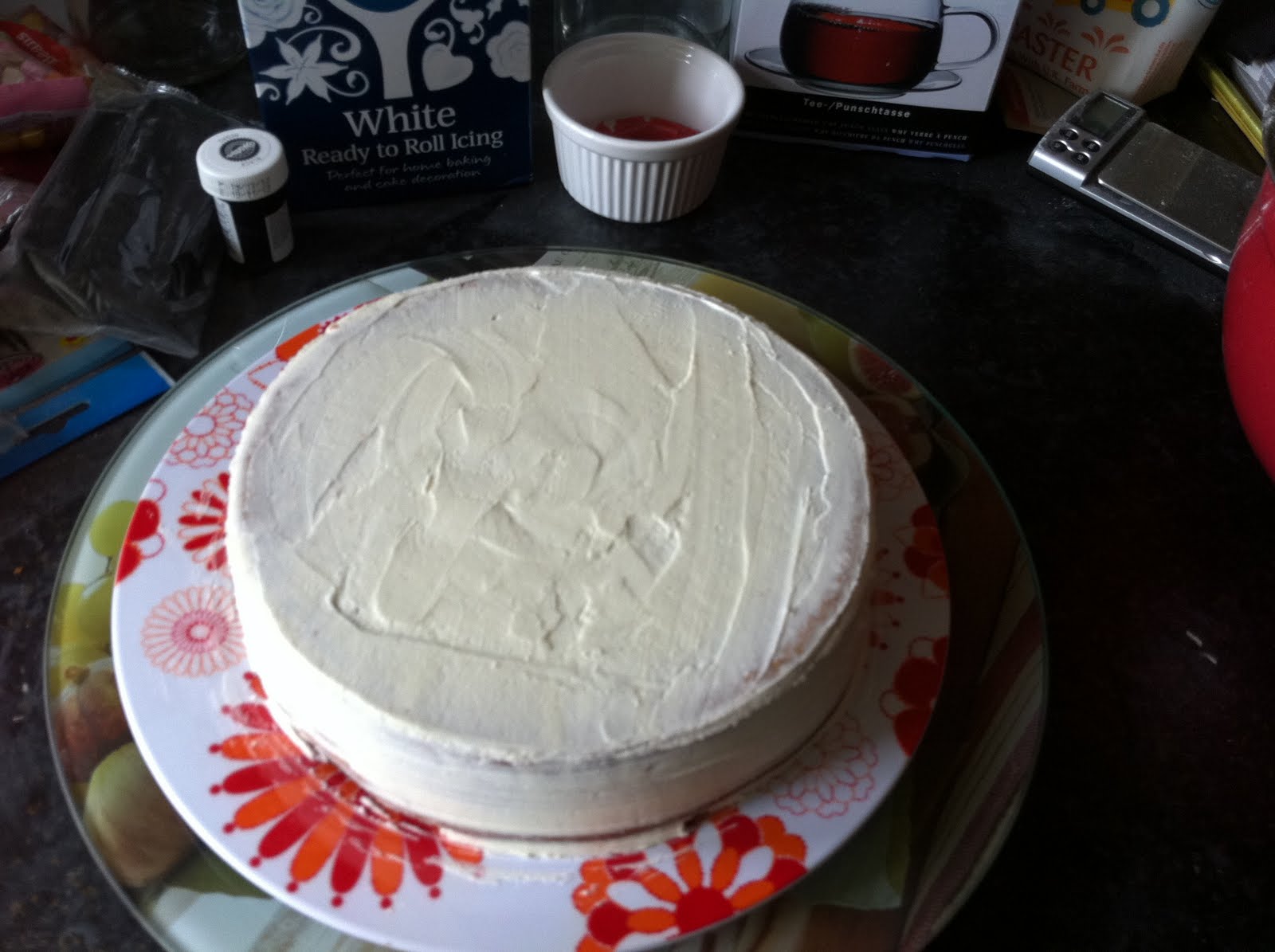
This is where the fun starts! While the cakes are in the oven, you can whip up the buttercream. Briefly whisk 300g room temperature butter to increase its surface area before whisking in a couple of tablespoons of 700g sifted icing sugar at a time. You will make a mess. Whisking through a hole in cling-film over the bowl could work, but is fiddly, and the cleanup operation doesn't take long. Each addition of sugar should be fully incorporated before the next. Once all the sugar has been blended in, add 2 tablespoons of milk (ideally whole, why skimp on the calories at this point?) and 1.5 teaspoons of vanilla essence. This is the point at which, should you be using the buttercream as standalone frosting, you could add food colouring, pastels working best. We're not using it for this, however.  If there are any particularly mutant-like lumps topping your cakes, these can be carefully carved off to create a flat surface. Then, using a pallet knife, cover the cake surfaces in buttercream like a master plasterer to smooth any dips, dents or bumps before chilling for half an hour. Repeat this so that you have 'plastered' two layers, the smoothness of the second being more important than the first. This will help the rolled icing to adhere to the cake and ensure a smooth finish, as well as adding a different texture to the finished mouthful.

Next it's time to cover your cakes. I bought a kilo of white icing and 300g of black from Hobbycraft, along with edible spray pearlescent icing, a small pack of orange icing, a pot of black food colouring paste and some cheap kids paintbrushes.  Stick the largest cake to a cakeboard, off centre in my case to allow for the 'headphones' later, using a blob of buttercream before kneading the white icing to soften. Dust a smooth work surface and a good rolling pin with a decent amount of icing sugar before rolling out your white icing into a round about twice the diameter of your cake and about 3mm thick. Use the rolling pin to lift the icing onto the cake and use the flat surfaces of your hands to smooth the icing onto the cake. You will need to carefully trim back the excess icing closely to the base of the cake. I used a thin 'rope' of black icing around the bottom perimeter - this handily disguises any uneven edges. You may additionally find it useful to dust your hands with icing sugar when smoothing the icing surfaces.  Reserving a ping-pong sized ball of kneaded black icing, create grey icing by kneading together the remaining black with white. Stick the next cake layer onto the centre of the base cake with buttercream and then protect the base cake with a sheet of greaseproof paper with a hole cut in it to fit over the second cake. This will stop you getting any grey smudged on your white base cake. Cover the second layer as before with the grey icing and then spray with the pearlescent icing, allowing to dry before removing the greaseproof and wrapping the base circumference with a black rope of icing.

You may want to cut out shapes from your leftover grey icing and spray these too, as I did with (40!) stars. I stick shapes onto my cakes with a blob of liquid glycerine, which can easily be bought from a supermarket, as this is clear and does not allow the shapes to slide.

Next for the record. I rolled out a disc of black icing as thinly as I could, whilst using as little icing sugar dusting as possible in order to keep the colour pure. This was cut slightly smaller in diameter than the top layer cake, and stuck to the top cake with glycerine. I used a clean comb to create the grooves, and painted the disc with glycerine to make it shiny.

To finish the record, I rolled an orange icing 'label', stuck this on as before and wrote on this using a fine paintbrush with the black gel food colouring. A silver candle provided the spindle. To make the arm, I wrapped a bendy straw in black icing and stuck this in a pillar of icing to the side of the top layer cake. The muffin-shaped cakes, with their lumpy tops, were perfect for headphones. I wrapped these in black icing, used a copper wire as the headband and a strawberry lace as the lead. And voilà! One turntable cake!

Check out my links on the left for details of Hobbycraft stores, for the spray icing as well as lots of other exciting supplies for whatever cake YOU decide to create!

I'd like to think that my cakes go down well, they certainly seem to!


Hearts

Butterflies

Turntable

Sunday, 19 June 2011

foodgasms (n. pl)

Let's take a detour. This blog may be called 'Sarah Serves' but this will not mean that it is restricted to tales of my culinary adventures. At times I will also share my views on those who Serve Sarah. And a few weeks ago, it was Heston Blumenthal, via the brilliance of his right-hand man at Dinner in the Mandarin Oriental hotel in Knightsbridge, Executive Chef Ashley Palmer-Watts.

Devotion to the cause, plus a nifty app, meant that S bagged a table for 6 as soon as round two of reservations opened and after a leave request, a painstaking wait and a guestlist shuffle, The Day arrived.

For those not in the know, Heston, of Bray's Fat Duck fame, rather enjoyed exploring what and how the British used to eat centuries ago, firstly through recreating dishes as per historical cookery books and then adding a modern twist to them, and this is the premise upon which Dinner is based. As such, the menu has dates and a bibliography.

The restaurant is within the Mandarin Oriental hotel and we rather enjoyed taking a pre-Dinner cocktail in the bar, which is suggestively decorated with beautiful back-lit liqueur bottles projecting their colours through opaque white walls like the ghosts of tipples future. The airy restaurant itself is shaped to allow a greater sense of intimacy than space between tables allows by breaking it into smaller sections, with a glass-walled kitchen so you can catch the magic on action. Including the spit-roasted pineapple (more on this later!)


We'd managed to secure ourselves a table overlooking Hyde Park, from which we could watch the Boris bikes and horses go by - if we could take our eyes off our plates for long enough. We got straight to the business of choosing dishes, with a desperation to try as many if each others' as possible. Nothing brings out the primeval pseudo-altruism more than a great meal, and it was clear that we would all feign charity with our own dishes because we simply HAD to try everyone else's.

Our beautiful-eyed cockney waiter talked us through some of the technicalities of the menu and we set about our battle plan with the zeal of oil prospectors. I assumed I'd have the meat fruit but did a deal with S, R and M, to secure a taste of it as well as Salamugundy (R's choice; as a medievalist by profession she was determined to restrict her meal to a set date period) and lemon salad in exchange for some of my marrowbone. Not my actual own personal marrowbone, you understand, although in retrospect, I possibly would.


Roast Marrowbone

Meat Fruit

Salamugundy
  Roast Marrowbone (c.1720)           Meat Fruit (c.1500)                Salamugundy (c.1720)

The Marrowbone salad was surprisingly light and subtly complimented with parsley and anchovy. I am usually wary of anchovies, finding the often limp fishiness atop a pizza to be a world away from the lipsmackingly melted saltiness in a lamb joint, but here it worked. The meat fruit was smoother than I had imagined, having seen it born on Heston's Dinners and remembering it more as rillettes, and was like the most sublime foie gras in it's butteriness, the mandarin jelly coating adding the perfect amount of intrigue. Salamugundy involved chicken oysters, the revered mouthful of dark meat from the back of the chicken ( http://en.m.wikipedia.org/wiki/Oyster_(fowl) ) which Louis XIV would insist on being the only part he ate. I now see why.


                                 Lemon Salad (c.1730)                         Roast Scallops (c.1820)

The lemon salad made me mourn the fact that goats curd cannot be bought within 500 yards of
my kitchen.  I missed out on trying the scallops, and need to overcome my unreasonable grudge about this, having not shared any of my dish with J in return.

Main courses followed a similar sharing pattern. Most ordered the powdered duck or the spiced pigeon, and M ordered the roast quail.

Powdered Duck
Powdered Duck (c.1670)

Spiced Pigeon
Spiced Pigeon (c.1780)  

Roast Quail
Roast Quail (c.1590)

Powdered duck is most closely related to a confit, with the addition of a protective salt shroud - the powder - which keeps the flesh moist and tender during it's six-hour cooking. The rich gravy helped this further. Fennel - which I really should cook with more - is not an accompaniment I would usually place with duck, nor one I would smoke, but it both took on the duck juices and leant a vibrancy to the meatiness of the dish. The puréed potato was a star in itself, a beauty that must easily have been 50/50 butter to potato, and that avoided being greasy but not having my greasy fingers swipe the bowl clean. See, primeval, like I said.

The quail was accompanied by smoked parsnip, creating a harmonious rich, sucré salé mouthful. The pigeon was beautifully tender and delicately, yet sweetly spiced, served with artichokes artfully arranged as camouflaged bones.

And then dessert. I may have surprised myself by not having the meat fruit, but I sure as hell was having the tipsy cake. This is where the famed spit-roasted pineapples mentioned earlier come into play. Tipsy cake is a brioche pudding, steeped in a sweet, buttery light rum liqueur to create a rich, custardy puddle at the bottom of its individual casserole and served with pineapple. The pineapples are roasted for 2-3 hours, depending on size, and the dessert must be ordered at the beginning of the meal. This is because it takes 30 minutes to cook, and requires 'basting' with liqueur every three minutes throughout this time.

Wow. My tipsy cake was luxurious, and yet light, the pineapple lending citrus freshness despite their caramelised syrup.

Chocolate Bar (c.1730)
I'm normally a stickler for a chocolate dessert but had no interest whatsoever in the 'Chocolate Bar' on offer this time, leaving it to J to enjoy, as much as the passion fruit and ginger ice cream intrigued me. Today, I was all about the fruit.

Summer Tart (c.1720)


I also tried R's summer tart with camomile and a biscuit ice cream, bang on trend with edible flowers and satisfying in its lightness.


Chocolate Wine (c.1710)

M enjoyed the chocolate wine, the two warm ingredients of dark chocolate and red wine having been merged through centrifugal force, and the accompanying Millionaire Tart would have taken a minimum of 5 hours to put together by R's reckoning based on Heston's 'In Search of Perfection' recipe.
Malted Barley Ice Cream (c.1830)


S decided to treat himself to a rather regal glass of dessert wine to accompany his malted barley and salted caramel ice cream, and having been allowed a sip I can attest to it's being worth it for a special occasion.


Still with me? We've not finished! Our beautiful-eyed cockney waiter brought us an earl grey ganache in a tiny teacup with a caraway biscuit. It was rather dribbly and therefore difficult to eat but no less delicious for it, it's bergamot notes singing through. E in particular enjoyed getting messy with this one.


I enjoyed an espresso with mine, but there was also some white tip tea and a 1970 Puerh on the table.


Dinner done, and at a price not at all unreasonable for such an experience, we went for a wander in the nearby rose garden in Hyde Park as a perfect finish to a wonderful few hours. Senses overwhelmed, I sat in the glorious sunshine people watching, and contemplating how lucky I am to have a table of appreciative gourmets in my close circle until sunset, when I headed home with a wide grin.